

Key Concepts in AI and Scrum
Key Concepts in AI and Scrum
The Rise of AI in Scrum Agile Projects
Imagine you're leading a finance project aimed at revamping the budgeting process in a large corporation. You're using Scrum, a popular agile framework, but you want to inject AI to enhance efficiency and decision-making. Why does this matter now? The finance sector is rapidly evolving with the integration of AI, making it crucial to understand how these technologies can be practically applied within agile methodologies like Scrum.
Understanding AI and Scrum in Finance
Artificial Intelligence (AI): A branch of computer science focused on creating systems capable of performing tasks that usually require human intelligence. This includes problem-solving, learning, and adapting to new situations.
Scrum: An agile framework for managing complex projects. It is characterized by iterative progress through sprints, with regular reflections and adaptations.
In the finance sector, the convergence of AI and Scrum offers a transformative approach to managing projects, improving data accuracy, and delivering better financial insights.
Key Concepts: Definitions and Principles
AI Concepts in Scrum:
-
Machine Learning: AI systems that learn from data and improve over time. In finance, this can optimize tasks like forecasting and fraud detection.
-
Natural Language Processing (NLP): Helps automate processes like report generation and customer interaction.
-
Predictive Analytics: Utilizes historical data to make predictions, aiding in strategic financial decisions.
Scrum Framework Basics:
-
Sprints: Short, iterative work cycles, usually 2-4 weeks, allowing teams to adapt quickly.
-
Roles: Includes the Product Owner, Scrum Master, and Development Team, each with specific responsibilities.
-
Artifacts: Includes Product Backlog, Sprint Backlog, and Increment, which keep the project on track.
Understanding these foundational concepts enables teams to effectively implement AI strategies within the Scrum framework, ensuring that projects remain agile while leveraging advanced technologies.
Unpacking Best Practices and Pitfalls
Let's delve deeper into how AI can be successfully integrated into Scrum, focusing on best practices and common pitfalls.
Best Practices:
-
Iterative Implementation: Introduce AI components gradually in each sprint to manage complexity and reduce risk.
-
Collaborative Cross-Functionality: Encourage communication between data scientists and Scrum teams to ensure AI solutions align with project goals.
-
Continuous Learning: Use retrospective meetings to analyze AI effectiveness and refine models.
Common Pitfalls:
-
Overcomplicating AI Models: Implementing overly complex AI solutions can hinder progress and confuse stakeholders. Start simple and enhance over time.
-
Ignoring Data Quality: AI relies heavily on high-quality data. Ensure robust data cleansing and validation processes.
Below is a table comparing successful and challenging AI integration in Scrum.
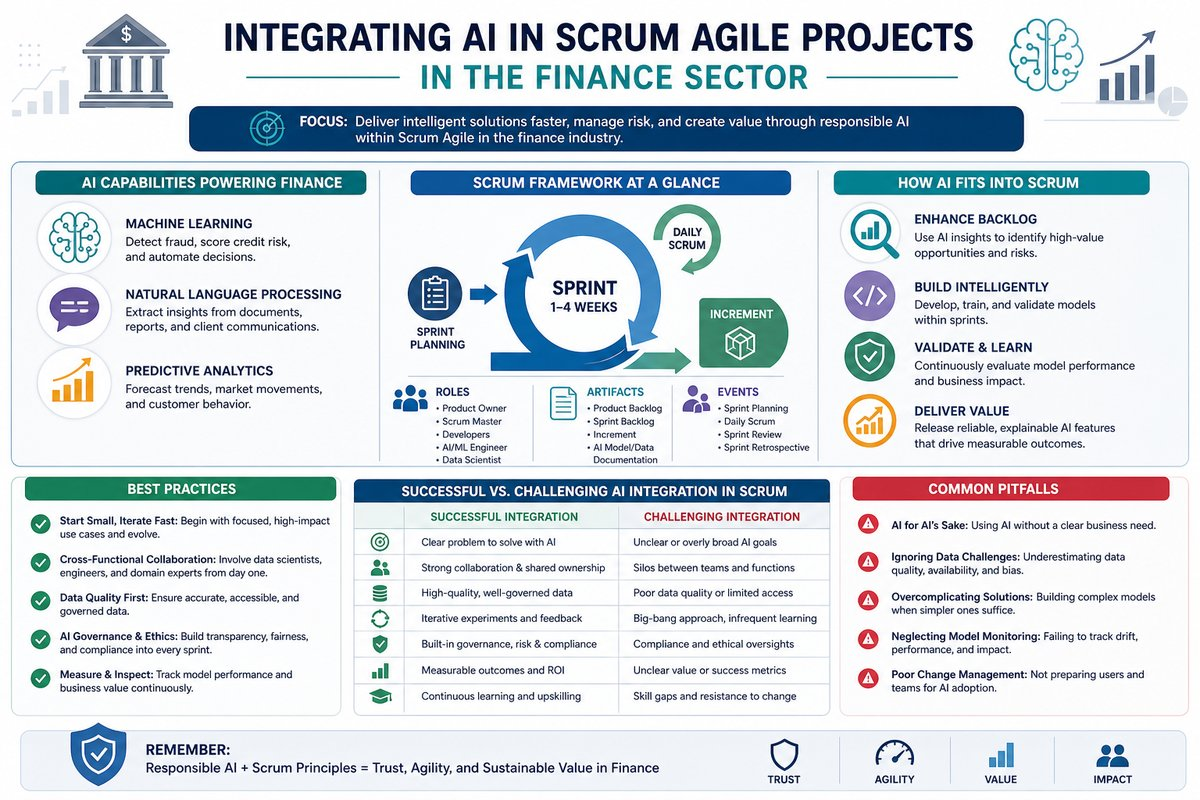
| Dimension | Successful Integration | Challenging Integration |
|---|---|---|
| Approach | Gradual and iterative | Abrupt and complex |
| Cross-Functionality | High team collaboration | Siloed teams |
| Data Management | Emphasizes data quality and cleaning | Neglects data integrity |
Real-World Finance Applications
Case Study 1: Automated Budget Analysis
In a leading financial firm, AI-driven analytics automated the budget analysis process. Using machine learning, the Scrum team developed models to predict budget variances with high accuracy. The result? A 30% reduction in analysis time, allowing teams to focus on strategic tasks.
Impact: Enhanced decision-making and resource allocation efficiency.
Case Study 2: AI in Risk Management
A bank integrated NLP algorithms within its Scrum framework to automate risk report generation. By analyzing large datasets, the AI could identify potential financial risks faster than traditional methods.
Impact: Reduced risk analysis time and prevented potential losses.
Bringing It All Together
AI and Scrum together provide a powerful toolkit for tackling complex finance projects. By understanding the synergy between these technologies, teams can navigate the complexities of today's financial landscape effectively. Keep these key takeaways in mind:
-
Gradual integration of AI: Avoid overwhelming teams by iteratively incorporating AI solutions.
-
Data is crucial: High-quality data is the backbone of successful AI implementations.
-
Cross-functional collaboration: Ensures AI tools meet practical needs and achieve desired outcomes.
Now that the foundation is in place, we'll move into Integrating AI into Scrum Frameworks.