

Examining Scrum Artifacts
Examining Scrum Artifacts
Understanding Scrum Artifacts in Finance
Imagine you're leading a Scrum team at a financial firm, tasked with developing an automated reporting system. Transparency and communication are key, but how do you ensure everyone—developers, stakeholders, and clients—remains informed and aligned? This is where Scrum artifacts play a crucial role.
Scrum artifacts offer structured ways to visualize the work being done, providing clarity and focus. Let’s explore what these artifacts are and why they matter in financial projects.
Exploring Key Scrum Artifacts
To fully leverage Scrum artifacts, you first need to understand what they are:
-
Product Backlog: A prioritized list of tasks and requirements for the product. It evolves with the project.
-
Sprint Backlog: Subset of the Product Backlog focused on the current sprint, with tasks the team plans to complete.
-
Increment: The sum of all completed backlog items during a sprint, creating a partial or complete product.
These artifacts ensure that work is transparent and the team stays aligned with goals and deadlines.
Diving Deeper into Each Artifact
Product Backlog
The Product Backlog is a dynamic to-do list that captures everything known to be needed in the product. Key aspects include:
-
Prioritization: Items are prioritized based on customer needs and business value.
-
Refinement: Items are constantly added, removed, or reprioritized.
This process helps financial projects remain agile, adaptable to changes in regulatory requirements or market conditions.
Sprint Backlog
The Sprint Backlog is critical to keeping the team focused and productive:
-
Commitment: Items in the Sprint Backlog are selected by the team, ensuring they are achievable within the sprint.
-
Transparency: It provides a clear view of what the team plans to achieve, fostering accountability.
For instance, the finance team might focus a sprint on integrating a new tax regulation within the system.
Increment
The Increment is a visible, tangible delivery of progress:
-
Quality: Each increment must meet the Definition of Done, ensuring it’s potentially releasable.
-
Value: Incremental delivery allows for early feedback and improvements, essential for meeting compliance standards.
Table: Comparing Scrum Artifacts
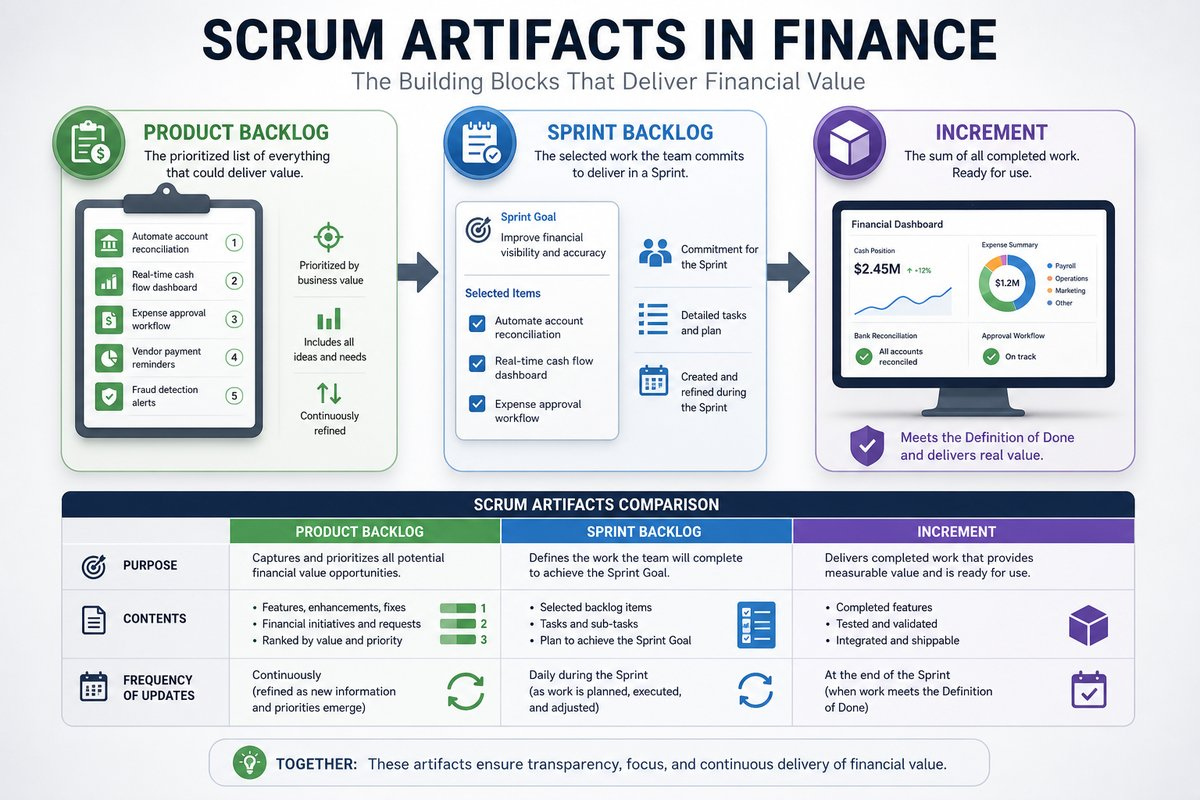
| Artifact | Purpose | Contents | Frequency of Updates |
|---|---|---|---|
| Product Backlog | List all desired work. | Tasks, features, requirements | Continuously |
| Sprint Backlog | Focus teams on current tasks. | Selected Product Backlog items | Per sprint |
| Increment | Ensure tangible progress. | Completed items meeting Definition of Done | After each sprint |
Real-World Examples in Finance
Automating Financial Reports
A finance team uses Scrum to automate quarterly reports. They utilize the Product Backlog to list features like data visualization tools and compliance checks. By refining these features, the team ensures each sprint increment improves the reporting system's accuracy and speed.
Implementing Regulatory Changes
When new financial regulations are announced, the Sprint Backlog becomes crucial. The team selects regulation-specific tasks, focusing on compliance updates and testing within the sprint, ensuring the company adapts swiftly and maintains compliance.
Bringing It All Together
Scrum artifacts are pivotal in navigating the complexities of financial projects by enhancing transparency, ensuring priorities align with organizational goals, and facilitating regular product improvements.
Next, we'll build on this by exploring Aligning Scrum with AI in Finance, examining how AI tools can further enhance these processes.