

Machine Learning and Data Analysis
Machine Learning and Data Analysis
Machine Learning and Data Analysis in Finance
The Importance of AI in Financial Projects
Imagine you're working on a team tasked with enhancing investment strategies for a finance company. The world of finance hinges on accurate predictions, efficient data management, and intelligent decision-making. Machine Learning (ML) and Data Analysis are vital tools in this process. These technologies not only streamline operations but also provide deeper insights and predictive capabilities.
The integration of AI in Scrum Agile projects promises to transform how financial institutions operate, offering a competitive edge in a challenging market. In this lesson, we'll explore the key concepts of ML and Data Analysis, and how they're applied in finance.
Understanding Machine Learning and Data Analysis
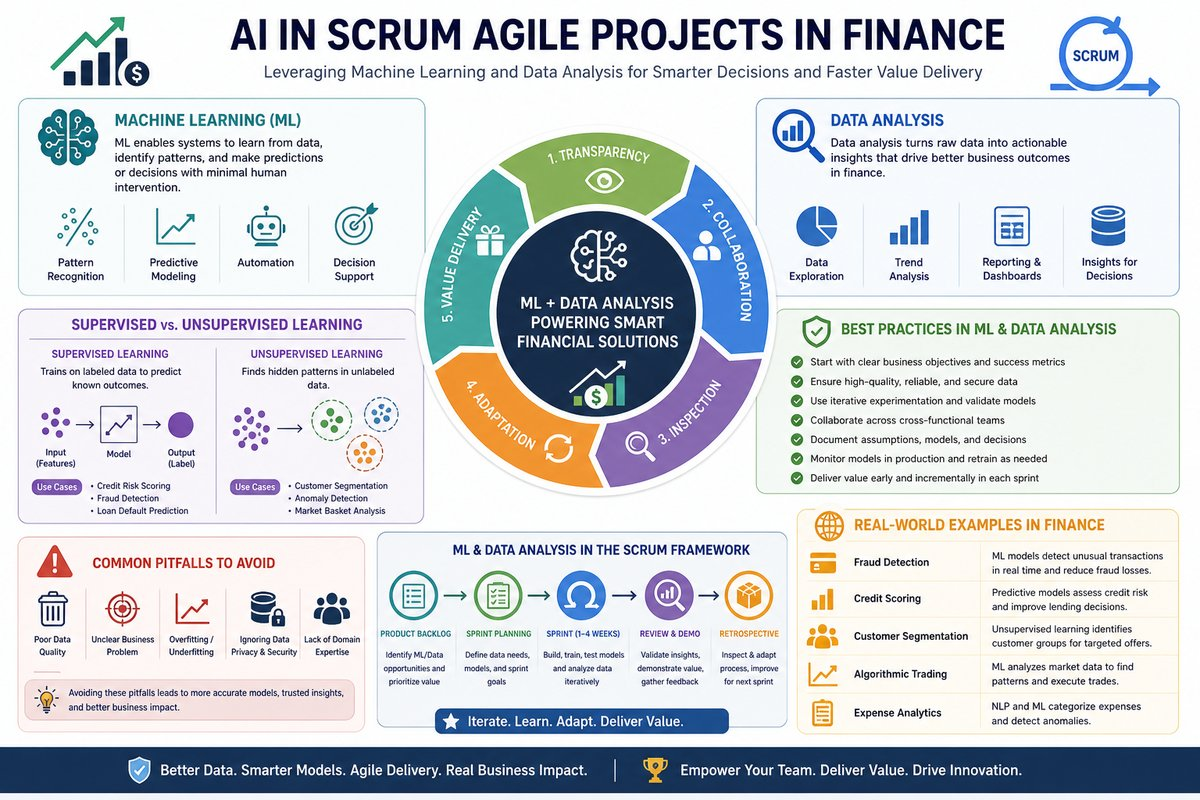
Machine Learning (ML): At its core, ML is a subset of artificial intelligence focusing on building applications that improve through experience without being explicitly programmed. In finance, ML models help in predicting stock prices, identifying fraudulent activities, and managing risks efficiently.
Data Analysis: This involves inspecting, cleansing, transforming, and modeling data to discover useful information. It plays a crucial role in decision-making processes within financial sectors.
Together, ML and data analysis allow financial teams to develop sophisticated models that predict trends, automate trading, and analyze large datasets swiftly and accurately.
Exploring Machine Learning Techniques
Supervised and Unsupervised Learning
-
Supervised Learning: Uses labeled data to teach models to predict outcomes. It’s extensively used in credit scoring and risk assessment in finance.
-
Unsupervised Learning: Identifies patterns or groupings within unlabeled data, often used for clustering clients based on transaction behaviors, improving customer segmentation.
Both techniques apply in various financial tasks, offering insights that might be missed through conventional analysis.
Best Practices in ML Deployment
-
Data Quality: Ensure data is clean and relevant. Garbage in leads to garbage out.
-
Model Selection: Choose models that fit the problem's complexity. Simpler models can be just as effective as complex ones with less computation.
-
Evaluation: Regularly test model accuracy using historical data to ensure predictions remain reliable over time.
Common Pitfalls
-
Overfitting: When models capture noise instead of the underlying pattern. Regularization and cross-validation can mitigate this.
-
Bias: Bias in data leads to skewed results. Awareness and adjusting models accordingly help maintain accuracy.
Real-World Examples in Finance
Automating Risk Management
Consider a bank using ML algorithms to predict loan defaults. By analyzing historical client data, the model identifies patterns indicating high-risk clients. This predictive power allows the bank to adjust lending criteria and reduce potential losses.
-
Impact: Enhanced risk prediction leads to better financial stability and customer trust.
-
Limitations: Model accuracy depends heavily on the quality and variety of input data.
Enhancing Investment Strategies
A hedge fund might use data analysis to refine its stock pick algorithms. By processing real-time data from various financial markets, the model can suggest optimal buy and sell timings.
-
Impact: Increases the fund's profitability by optimizing investment moves.
-
Limitations: Market volatility may impact model effectiveness, requiring constant updates and adjustments.
Tying It All Together
In conclusion, ML and data analysis are transformative tools in finance, offering unparalleled insight and automation. Understanding their principles, implementing best practices, and applying them in real-world scenarios allows financial institutions to operate more efficiently and effectively.
Now that the foundation is in place, we'll move into AI Transformations in Finance to explore these applications further.