

AI Transformations in Finance
AI Transformations in Finance
How AI is Shaping the Future of Finance
The financial sector is undergoing a profound transformation due to the integration of Artificial Intelligence (AI). Imagine a scenario where investment decisions are made in real time based on massive datasets, or credit risk is assessed with higher accuracy using predictive models. These advancements are more than just futuristic concepts; they are practical applications driving efficiency and innovation in the finance industry today.
Understanding AI in Finance
Artificial Intelligence (AI): At its core, AI involves machines that can perform tasks typically requiring human intelligence. These include learning from data, recognizing patterns, and making decisions.
Machine Learning (ML): A subset of AI, ML uses algorithms to parse data, learn from it, and make informed predictions or decisions.
Natural Language Processing (NLP): This technology allows computers to understand and respond to human language, which is critical for applications like customer service chatbots and sentiment analysis.
In previous contexts, we explored how AI affects Agile methodologies in project management. Now, let's focus specifically on finance and how these technologies redefine operations and strategies.
Transformative AI Technologies
AI’s impact on finance involves several key technologies:
-
Algorithmic Trading: Utilizing algorithms to automate trade execution, increasing speed and often improving outcomes versus traditional methods.
-
Fraud Detection: AI models analyze transaction patterns to flag fraudulent activities early, enhancing security.
-
Risk Management: Predictive analytics assess risk with greater precision, enabling better decision-making.
Comparison of Traditional vs. AI-Driven Processes
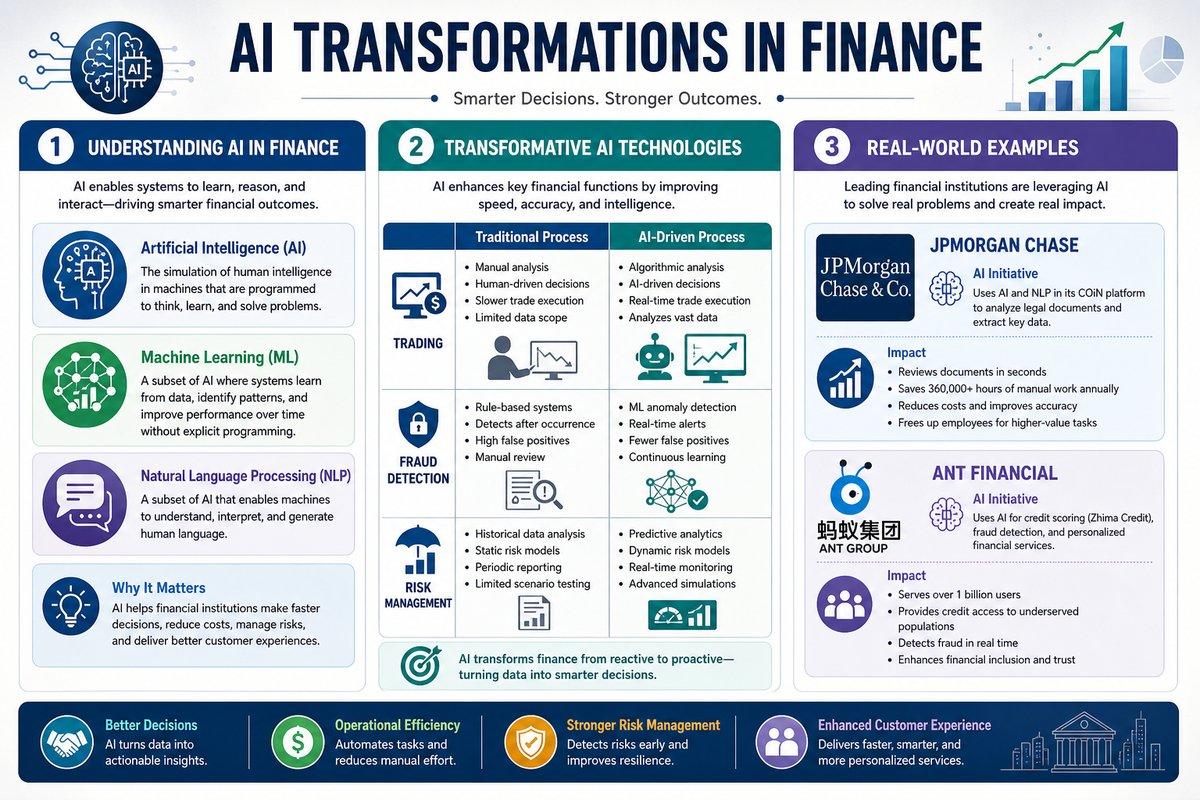
| Aspect | Traditional Process | AI-Driven Process |
|---|---|---|
| Trading | Manual and slower reaction times | Automated and executes within seconds |
| Fraud Detection | Reactive, based on historical data | Proactive, using real-time data analysis |
| Risk Management | Heavily reliant on historical trends | Predictive, incorporating diverse variables |
In-Depth Exploration: Applications and Impact
- Algorithmic Trading:
Mechanism: AI systems execute trades automatically based on pre-set criteria and real-time data analysis.
Benefits: Increases the speed and accuracy of trades, reduces human error, and can adapt to market changes more swiftly.
Challenges: Requires sophisticated infrastructure and poses potential market risks if not properly managed. - AI in Credit Scoring:
Mechanism: Uses diverse data sources beyond traditional financial records to evaluate creditworthiness.
Benefits: Offers more accurate assessments and can provide opportunities to those previously overlooked by traditional methods.
Limitations: Ethical considerations around data privacy and the potential for bias in the data inputs. - Fraud Prevention:
Mechanism: Continuous monitoring and pattern recognition help identify unusual transactions.
Benefits: Enhances security, minimizes losses, and builds consumer confidence.
Pitfalls: High dependence on data quality and the need for ongoing algorithm updates.
Real-World Examples in Finance
Example 1: JPMorgan Chase’s AI Initiatives JPMorgan Chase uses AI to automate document reviews, significantly reducing the time from thousands of hours to just seconds. This AI application, known as COiN (Contract Intelligence), exemplifies efficiency gains achievable through AI.
- Impact: Frees up valuable labor, reduces errors, and accelerates processes.
Example 2: Ant Financial’s Credit Scoring The Chinese firm Ant Financial employs AI to evaluate customer creditworthiness using a wide array of data points, enabling them to offer financial products to a broader audience.
- Impact: Increases access to credit, while managing risk more effectively through enhanced data modeling.
Conclusion: Embracing AI in Finance
The integration of AI into finance offers transformative potential, redefining how firms operate, enhance security, manage risks, and serve customers. As AI continues to evolve, its strategic application within finance will remain crucial for maintaining competitive advantage.
Next, we'll build on this by exploring Ethical Considerations in AI for Finance.