

Identifying AI-Driven Improvements in Finance
Identifying AI-Driven Improvements in Finance
Harnessing AI for Financial Improvements
Imagine a financial analyst at a Fortune 500 company, scanning through mountains of data to predict market trends and make informed investment recommendations. The process is laborious and error-prone. How can AI make this easier and more accurate? Let's explore how AI transforms finance by driving improvements within Agile Scrum projects.
Understanding AI in Finance
AI, or Artificial Intelligence, refers to computer systems capable of performing tasks usually requiring human intelligence. In finance, AI is used for tasks such as risk assessment, fraud detection, and customer service via chatbots. Its integration is crucial for enhancing efficiency and accuracy in financial operations.
Agile Scrum, a framework for effective project management, benefits from AI by improving decision-making processes with data-driven insights. This intersection of AI and Agile methodologies presents a powerful toolset for financial improvement.
Progressive Integration of AI: From Basics to Best Practices
Enhancing Data Analysis and Insights
AI enhances financial analysis by:
-
Automating Data Processing: Reducing manual work and increasing the speed of analysis.
-
Predictive Analytics: Using historical data to forecast future trends.
-
Natural Language Processing: Interpreting unstructured data from reports and social media.
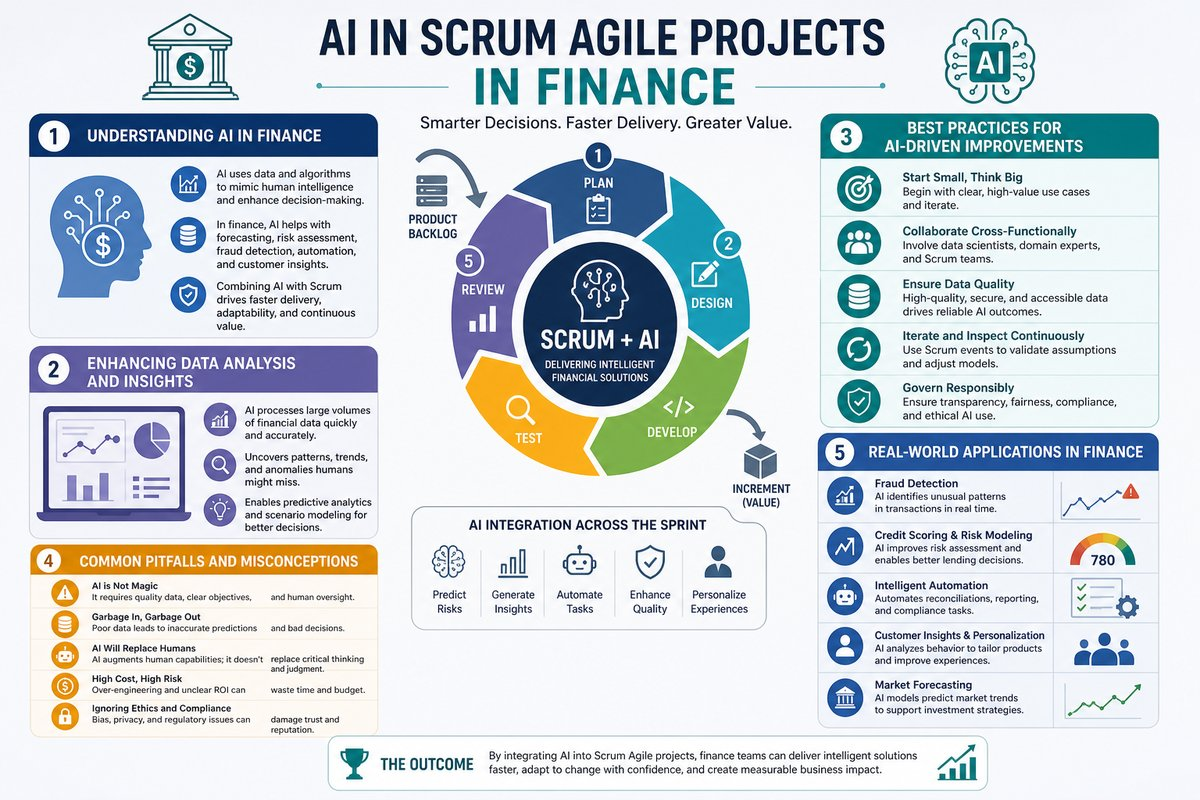
Implementing AI requires understanding its integration within a Scrum framework. Here’s how AI aligns with Scrum:
-
Sprint Planning: AI tools can analyze past sprints to predict outcomes and optimize resource allocation.
-
Daily Scrums: AI provides real-time data, allowing teams to address issues immediately.
-
Sprint Reviews: AI can generate reports that offer insights into team performance and project outcomes.
Best Practices for AI-Driven Improvements
- Define Clear Objectives: Clearly outline what you aim to achieve with AI implementation.
- Start Small: Pilot AI initiatives within a small scope before wider adoption.
- Data Integrity: Ensure data used by AI systems is accurate and reliable.
- Continuous Learning: Keep systems updated with the latest algorithms and techniques.
Common Pitfalls and Misconceptions
-
Pitfall: Over-reliance on AI without human oversight.
Solution: Combine AI insights with human expertise for balanced decision-making. -
Misconception: AI will replace financial experts.
Clarification: AI supports experts by handling repetitive tasks, freeing them to focus on complex analyses.
Real-World Applications in Finance
Example 1: Enhancing Risk Management
A global bank uses AI to predict credit risks by analyzing customer behavior and transaction history. The AI tool identifies patterns that might indicate potential defaults, enabling the bank to adjust credit limits and interest rates accordingly.
Impact:
-
Proactive Measures: The bank can intervene early to mitigate risk.
-
Increased Accuracy: More precise risk assessment than traditional methods.
Example 2: Improving Customer Experience
A financial services firm deploys AI chatbots to handle customer inquiries. These chatbots can answer queries about account balances, loan applications, and more, freeing up human agents for complex cases.
Benefits:
-
Increased Efficiency: Faster response times for customers.
-
Cost Savings: Reduced need for large call center staff.
Bringing It All Together
AI is redefining finance by enhancing accuracy, efficiency, and customer satisfaction. Its integration into Agile Scrum projects facilitates a smoother, data-driven decision-making process that benefits both the organization and its clients.
Up next, "Overcoming Challenges in AI Adoption" will delve into addressing common obstacles faced when integrating AI into financial projects.