

Integrating AI Tools into Scrum
Integrating AI Tools into Scrum
Exploring AI Integration in Scrum for Finance
In the fast-paced finance industry, staying ahead requires innovation and adaptability. Integrating AI tools into Scrum Agile projects is a strategy many financial firms are adopting to enhance efficiency and decision-making capabilities. This approach can streamline operations, improve accuracy in forecasting, and drive more meaningful insights from data. Let’s explore how AI can revolutionize the way Scrum teams operate within financial projects.
Understanding the Basics
Scrum and AI Defined
-
Scrum: A framework within Agile project management that facilitates adaptive solutions for complex projects through collaboration, accountability, and iterative progress.
-
AI (Artificial Intelligence): Technology that enables machines to perform tasks that typically require human intelligence, such as decision-making, language understanding, and pattern recognition.
Relevance in Finance
AI integration in Scrum can lead to:
-
Enhanced data analysis for better financial forecasting.
-
Automation of routine tasks, freeing up time for more strategic planning.
-
Improved risk management by anticipating market shifts and anomalies.
Integrating AI Tools Step-by-Step
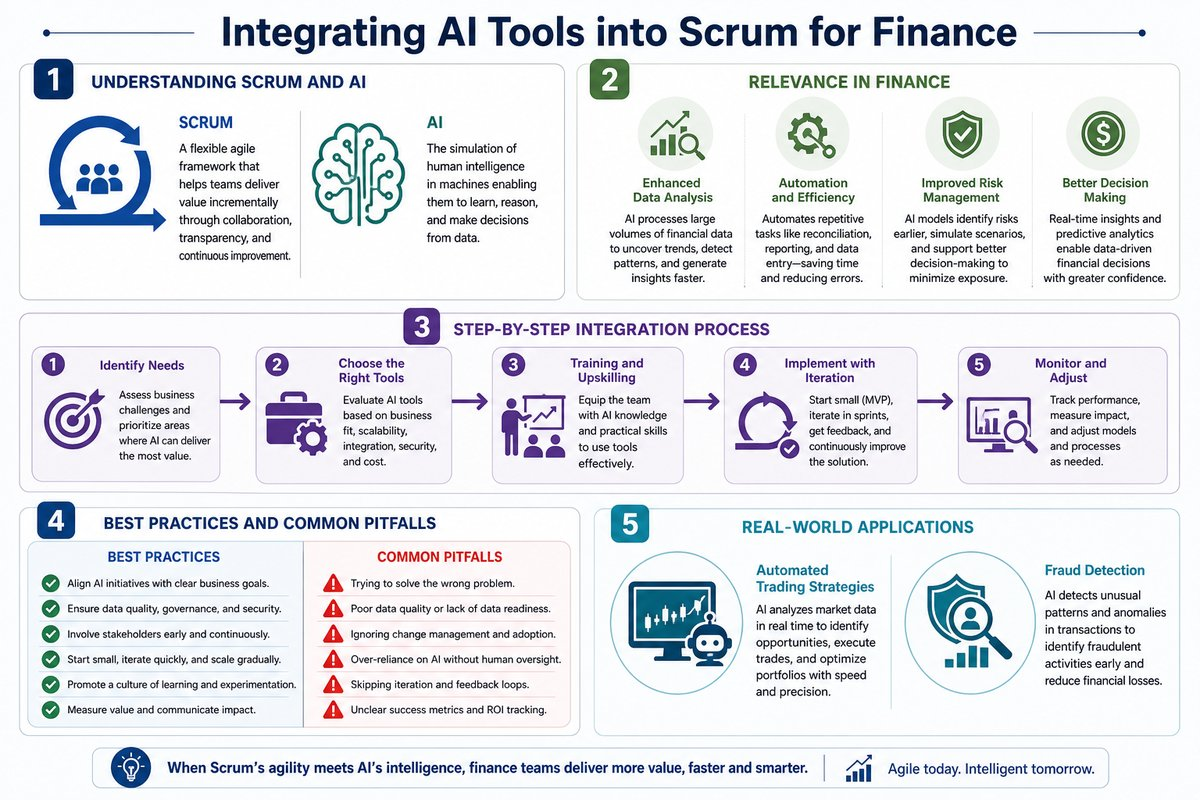
Successful AI integration in Scrum involves several key steps:
- Identify Needs: Start by determining which part of the Scrum process would benefit most from AI tools. This could be anything from backlog prioritization to sprint planning.
- Choose the Right Tools: Select AI tools that align with your specific project requirements. Options include machine learning models for data analysis, AI-driven communication tools, or predictive analytics software.
- Training and Upskilling: Ensure all team members understand how to use the new technology effectively. This might involve training sessions or workshops.
- Implement with Iteration: Begin by integrating AI into smaller Scrum tasks. Use iterative sprint cycles to gradually incorporate more complex AI functionalities.
- Monitor and Adjust: Continuously assess the impact of AI integration. Gather feedback from Scrum teams and adjust the implementation process as needed.
Best Practices and Common Pitfalls
Best Practices
-
Start Small: Test AI tools in a limited capacity before scaling up.
-
Regular Assessment: Continuously evaluate AI performance within projects to ensure it meets expected outcomes.
-
Cross-Functional Collaboration: Encourage collaboration between AI specialists and Scrum teams to maximize effectiveness.
Common Pitfalls
-
Over-reliance on AI: Avoid depending solely on AI tools. Human oversight is crucial for nuanced decision-making.
-
Ignoring Change Management: Failing to manage team transitions can lead to resistance or misapplication of AI tools.
-
Inadequate Data Quality: Ensure data used for AI processes is accurate and comprehensive to avoid faulty outputs.
Real-World Applications in Finance
Automated Trading Strategies
AI tools in Scrum can be applied to develop automated trading algorithms. By incorporating machine learning models to analyze market trends and execute trades, financial institutions can improve their trading efficiency and profitability. This application involves:
-
Leveraging historical market data to train AI systems.
-
Using AI for real-time market analysis during sprints.
-
Continuously refining algorithms based on retrospective evaluations.
Fraud Detection
AI integrated into Scrum projects can enhance fraud detection for financial services:
-
Implementing machine learning to identify transaction anomalies.
-
Using sprint reviews to refine detection algorithms.
-
Combining human expertise with AI insights for deeper investigations.
Key Takeaways for Finance Teams
-
Enhanced Efficiency: AI tools can significantly reduce the time and effort required for data processing.
-
Improved Accuracy: AI provides more reliable projections and risk assessments by analyzing vast data sets.
-
Strategic Planning: Freeing team members from mundane tasks allows more focus on strategic initiatives and innovation.
Next, we'll build on this by exploring Identifying AI-Driven Improvements in Finance.