When “we monitor it” isn’t enough
A retailer launches an AI-driven pricing recommender. The deployment goes smoothly—until a data feed glitch makes the model think a key competitor dropped prices nationwide. Overnight, the engine recommends aggressive cuts, margins crater, and store managers start overriding prices manually. The next morning, leadership asks three uncomfortable questions: When did we first know something was wrong? Can we prove what the system did and why? And who signed off on the risk of letting it run this way?
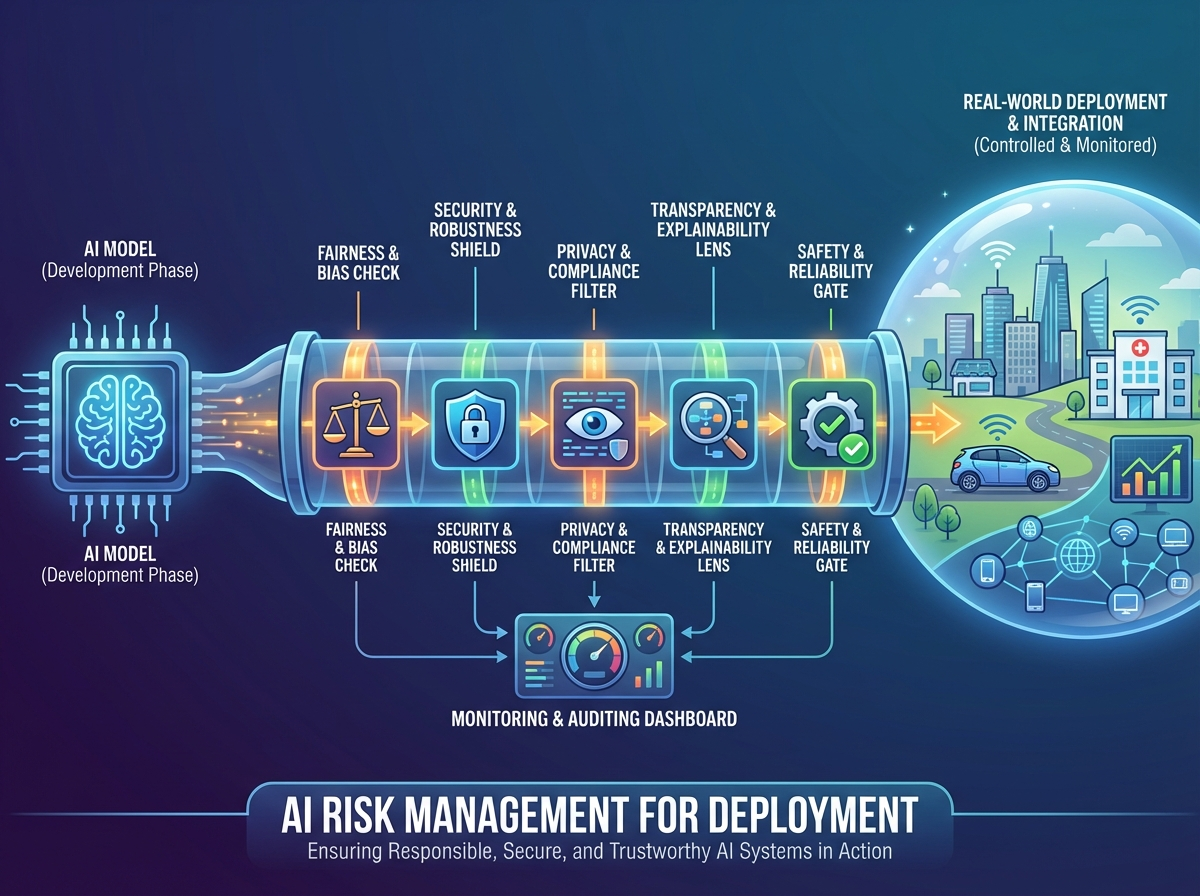
That’s the operational reality behind monitoring, auditability, and evidence. AI risk doesn’t just live in design-time decisions; it shows up in production—through drift, misuse, silent failures, and edge cases that only appear at scale. If your organisation can’t detect issues early, reconstruct decisions after the fact, and produce credible evidence that controls ran as intended, governance becomes “policy on paper.”
This lesson turns governance and control design into a running discipline: continuous oversight with provable traceability—without drowning teams in dashboards, logs, and bureaucracy.
The three outcomes you’re aiming for: visibility, traceability, defensibility
Monitoring, auditability, and evidence are tightly linked, but they are not the same thing. Monitoring is the live capability to detect risk-relevant signals and trigger action. Auditability is the ability to reconstruct what happened—data, model version, prompts, outputs, approvals, and user actions—so an independent party can validate claims. Evidence is the durable set of artifacts that demonstrate controls operated effectively across the lifecycle, not just that they were designed.
A helpful way to anchor these ideas is to reuse the control vocabulary from the prior lesson: preventive, detective, and corrective controls. Monitoring is how detective controls actually work in production (with thresholds, owners, and escalation). Auditability is what makes preventive and corrective controls reviewable and challengeable (configuration history, approval trails, incident records). Evidence is the “output” of the whole governance operating system—what internal risk, legal, security, and eventually external auditors can rely on.
Two principles keep this practical:
-
Govern the decision, not the model: you monitor and audit what matters to the decision context—impact, sensitivity, and autonomy—rather than collecting generic model metrics that don’t map to harm.
-
Evidence over intent: “we trained it to be safe” is not evidence. Evidence is something a third party could review later and reach the same conclusion you did.
Together, these outcomes let you answer the questions that matter during a real incident: What changed? What did the system do? Who knew? Who approved? What controls ran? What did we do to contain and prevent recurrence?
Monitoring that actually reduces risk (not just produces dashboards)
Monitoring becomes a governance tool only when it is tightly coupled to action. Many teams stop at observability—latency, uptime, token usage, accuracy on a stale test set—then are surprised when harm slips through. Governance-grade monitoring starts by asking: what failure modes create real-world impact in this workflow, and how do we detect them early enough to intervene?
A robust approach is to monitor across three layers of signals: model behavior, user behavior, and business outcomes. Model behavior includes things like spikes in refusal rates, unusual output length, increased “unsupported claim” flags, or retrieval misses in a grounded-RAG assistant. User behavior includes override rates (how often humans delete or rewrite suggestions), repeated re-prompts, escalation tagging, and “copy/paste to customer” patterns that indicate high reliance. Business outcomes include complaint categories, anomaly rates in downstream decisions, margin swings, stockouts, or policy exceptions—signals that might reveal “technically fine” model outputs causing operational harm.
Monitoring only works when it’s operationalized like a control: thresholds + owners + response paths. An alert without a named responder is noise. A dashboard without triggers is observability theater. For higher-risk tiers—especially where autonomy is high—monitoring should include risk-tiered sampling (targeting known sensitive topics like fees, eligibility, adverse actions) rather than purely random review that misses concentrated harms.
Common pitfalls and misconceptions show up repeatedly:
-
Misconception: “Monitoring is just model metrics.” In reality, the most governance-relevant signals often come from complaints, overrides, and downstream anomalies.
-
Pitfall: “Informational-only” dashboards. If nothing pages, nothing is controlled.
-
Pitfall: One-size-fits-all thresholds. A low-risk drafting assistant and a high-impact decision support tool should not share the same alerting model.
In practice, monitoring maturity is less about sophisticated tools and more about disciplined design: define the risks, pick the signals that correlate to those risks, and make sure every signal has an owner and a playbook.
Auditability: the ability to reconstruct the truth later
Auditability is the difference between “we think the model did X” and “we can prove the system did X, with these inputs, under this configuration, approved by these people.” It matters for internal challenge (risk, legal, security), for incident response, and for external scrutiny. Without auditability, corrective actions often degrade into guesswork, and governance committees can’t reliably validate whether controls are real or merely documented.
At an intermediate, practical level, auditability requires you to preserve the minimum set of traceability links across the AI lifecycle:
-
What was deployed: model/version, prompt/version, retrieval corpus/version, safety policy/version, configuration (autonomy caps, block rules), and release identifiers.
-
What happened at runtime: input context (appropriately minimized/redacted), outputs, tool calls/actions taken, and whether a human approved/edited before execution.
-
Who decided and when: approvals at lifecycle gates, exceptions granted, and sign-offs aligned to the risk tier and “three lines” ownership model.
-
What changed over time: a tamper-resistant change history—so you can connect an incident to a particular change in prompt, policy, data source, or UI flow.
This is where auditability must be designed alongside privacy and security rather than fighting them. You often need to retain some interaction trace to be defensible, but you must do it with controls like redaction before logging, least-privilege access, and retention limits aligned to policy. If you retain everything indefinitely “just in case,” you create a different kind of risk. If you retain nothing, you lose the ability to learn, respond, and prove control effectiveness.
Typical failure modes include:
-
Logging without linkage: you have logs, but can’t tie them to a specific model version or control configuration.
-
Human-in-the-loop ambiguity: you can’t tell whether a human actually reviewed, edited, or approved an output before it reached a customer.
-
Approval theater: decisions were “approved,” but you can’t trace what evidence was reviewed, what conditions were imposed, or what exceptions were accepted.
Auditability is not “more paperwork.” It’s a design choice: build systems so that key claims—safety constraints, human oversight, and risk acceptance—are verifiable later.
Evidence: proving your controls operated (and not just that they exist)
Evidence is the durable output that makes governance enforceable. Controls are only real if they produce something reviewable: configurations, thresholds, logs, approvals, evaluation results, monitoring alerts, incident records, and documented residual-risk decisions. The goal is not to satisfy an auditor in the abstract; it’s to make the organisation reliably answer, at any time: Are our controls working as designed? If not, what changed—and what did we do about it?
A useful way to think about evidence is by mapping it to the preventive/detective/corrective control types you already designed:
-
Preventive controls should yield evidence like access grants, data source approvals, redaction configuration, autonomy caps, blocked-topic rules, and pre-release evaluation results.
-
Detective controls should yield evidence like alert definitions, threshold histories, review sampling logs, override/escalation metrics, and triage records showing response times and outcomes.
-
Corrective controls should yield evidence like incident tickets, rollback records, root-cause analyses, control improvements, and documented risk acceptance when leadership chooses to proceed with residual risk.
Evidence must also be decision-grade: it should connect back to the governance question being asked. For example, “we have a safety checklist” is weaker than “here are the top failure modes for this use case, the thresholds we monitor, the last 30 days of alerts, and the documented actions taken.” The difference is specificity and linkage to risk tier and autonomy.
Two misconceptions commonly derail evidence programs:
-
Misconception: “If the committee approved it, we have evidence.” Approval is a decision point; evidence is what supports and validates that decision over time.
-
Misconception: “More evidence is always better.” Evidence that isn’t used becomes expensive noise and can increase security/privacy exposure. Good evidence is curated: minimal, relevant, and reviewable.
A practical north star is: Could an independent reviewer reconstruct what happened and assess whether controls were appropriate and followed—without relying on tribal knowledge? If the answer is yes, your evidence system is doing its job.
How monitoring, auditability, and evidence differ (and work together)
The easiest way to keep teams aligned is to make the distinctions explicit, while showing how they reinforce each other.
| Dimension | Monitoring | Auditability | Evidence |
|---|---|---|---|
| Primary purpose | Detect risk-relevant issues early enough to intervene | Reconstruct decisions and system behavior after the fact | Demonstrate controls operated effectively over time |
| Core question | “What is happening right now, and who responds?” | “What happened, exactly, under what configuration?” | “Can we prove governance and controls are real and effective?” |
| Typical artifacts | Alerts, thresholds, dashboards with triggers, triage logs | Versioning, change logs, approval trails, traceable runtime records | Control test results, sampling logs, incident reports, sign-offs, exception records |
| Common failure mode | Dashboards without owners or actionable thresholds | Logs without linkage (can’t tie outputs to versions/approvals) | “Documentation theater” that doesn’t map to actual risk reduction |
| Governance link | Powers detective controls | Makes preventive/corrective actions verifiable | Produces reviewable artifacts for committees and assurance functions |
[[flowchart-placeholder]]
Applied example 1: Bank LLM assistant for customer service agents (assistive, high sensitivity)
Consider the bank’s assistive LLM that drafts responses for agents while handling account-related questions. The governance classification is inherently higher sensitivity: customer data, policy commitments, and reputational risk. The monitoring and evidence design should reflect that the tool is assistive (human remains the decision-maker), but the exposure is still real because agents may copy/paste under pressure.
Step-by-step, a governance-grade setup looks like this:
First, define what “bad” looks like in this workflow: policy-violating fee waivers, misleading eligibility statements, and accidental disclosure of sensitive information. Then design monitoring signals that correlate to those harms. On model behavior, track retrieval misses (answers not grounded in approved sources), spikes in “unsupported claim” flags, and topic-based risk labels (fees, adverse actions, eligibility). On user behavior, track override rates (agents delete drafts), escalation tags, and rapid re-prompts—often a sign the model is failing on high-stakes queries. On business outcomes, monitor complaint categories like “misleading info” and escalations to supervisors.
Second, make the system auditable without creating a privacy incident. Log interaction traces with redaction before logging, cap retention to policy, and ensure each logged event is tied to prompt/version, retrieval corpus/version, and guardrail configuration. Crucially, capture whether the agent edited the draft and whether the final message sent to the customer was machine-suggested, human-authored, or mixed. That single link often determines whether “human in the loop” is real or merely assumed.
Impact, benefits, limitations:
-
Impact: faster agent handling time with fewer policy breaches that reach customers because violations trigger alerts and sampling review before they become patterns.
-
Benefit: defensibility—when an incident occurs, the bank can reconstruct the exact configuration and show what controls ran and how the case was handled.
-
Limitation: operational load is real. Sampling, triage, and threshold tuning require sustained ownership; if alerts become noisy or ownerless, monitoring quietly degrades into “best effort.”
Applied example 2: Retail dynamic pricing recommendations (impactful, constrained autonomy)
Dynamic pricing feels “internal,” but it carries consumer protection, fairness perception, and brand risk. Here, the key governance variable is autonomy: whether recommendations are merely suggestions to pricing managers or automatically executed within bounds. Monitoring and auditability should be designed around autonomy caps, anomaly detection, and rollback readiness—because small upstream errors can quickly become customer-facing outcomes.
Step-by-step in practice:
Start by encoding preventive constraints as auditable configuration: category-level autonomy rules (manual approval for sensitive categories, capped auto-execution for lower-risk ones), percentage-change caps, and “reason code required” policies for every recommendation. Then make monitoring explicitly governance-relevant. Track how often the system hits caps (a signal it “wants” to do something outside allowed bounds), override rates by region/category, and sudden distribution shifts in recommended prices that may indicate feed errors or market shocks. Pair these with business outcomes such as margin swings, stockouts, and unusual customer complaints—because a model can be statistically stable while still operationally harmful.
Auditability needs to let you reconstruct not only the model output but the decision chain: what data feed version was used, what competitor index was ingested, what rule/cap applied, who approved exceptions, and what was actually executed in channels. When something goes wrong, corrective control evidence matters: rollback to last-known-good rules, freeze automation for affected categories, and a documented root-cause review that updates controls (tighter feed validation, revised thresholds, adjusted caps).
Impact, benefits, limitations:
-
Impact: faster price responsiveness where safe, with containment when signals indicate abnormal market/data conditions.
-
Benefit: reduced “silent runaway” risk because cap-hits and anomaly alerts trigger action before brand damage accumulates.
-
Limitation: tuning is unavoidable. Overly conservative caps erase value; overly permissive autonomy turns minor feed glitches into major incidents. Monitoring is not set-and-forget—it’s an operating discipline.
Closing: run governance like a system, not a meeting
Monitoring, auditability, and evidence are the production layer of AI governance—the part that determines whether your controls survive contact with real users, real data shifts, and real incentives. When designed well, they reduce time-to-notice, time-to-recover, and the frequency of repeat incidents, while producing defensible artifacts for challenge and assurance.
Key takeaways:
-
Monitoring is only a control when it’s actionable: define thresholds, owners, and playbooks tied to risk-tiered failure modes—not generic dashboards.
-
Auditability is reconstructability: you need versioned configurations, traceable runtime records, and clear human-action trails to validate what happened.
-
Evidence is the product of real controls: approvals, logs, alerts, sampling reviews, incidents, and exceptions must link back to the decision context (impact, sensitivity, autonomy).
Now that the foundation is in place, we'll move into Regulatory & Board Oversight Alignment [20 minutes].