When “AI demand” turns into a budget fight
A business unit sees a competitor launch an AI assistant and asks for “something similar” this quarter. Another team is already piloting a forecasting model. A third wants to automate invoice matching with GenAI. Each sounds reasonable, each has a sponsor, and each can show a demo. Then the hard part starts: every initiative pulls on the same scarce constraints—data access, platform capacity, security review, MLOps support, and subject-matter experts—and funding conversations devolve into who shouts loudest, not what creates durable outcomes.
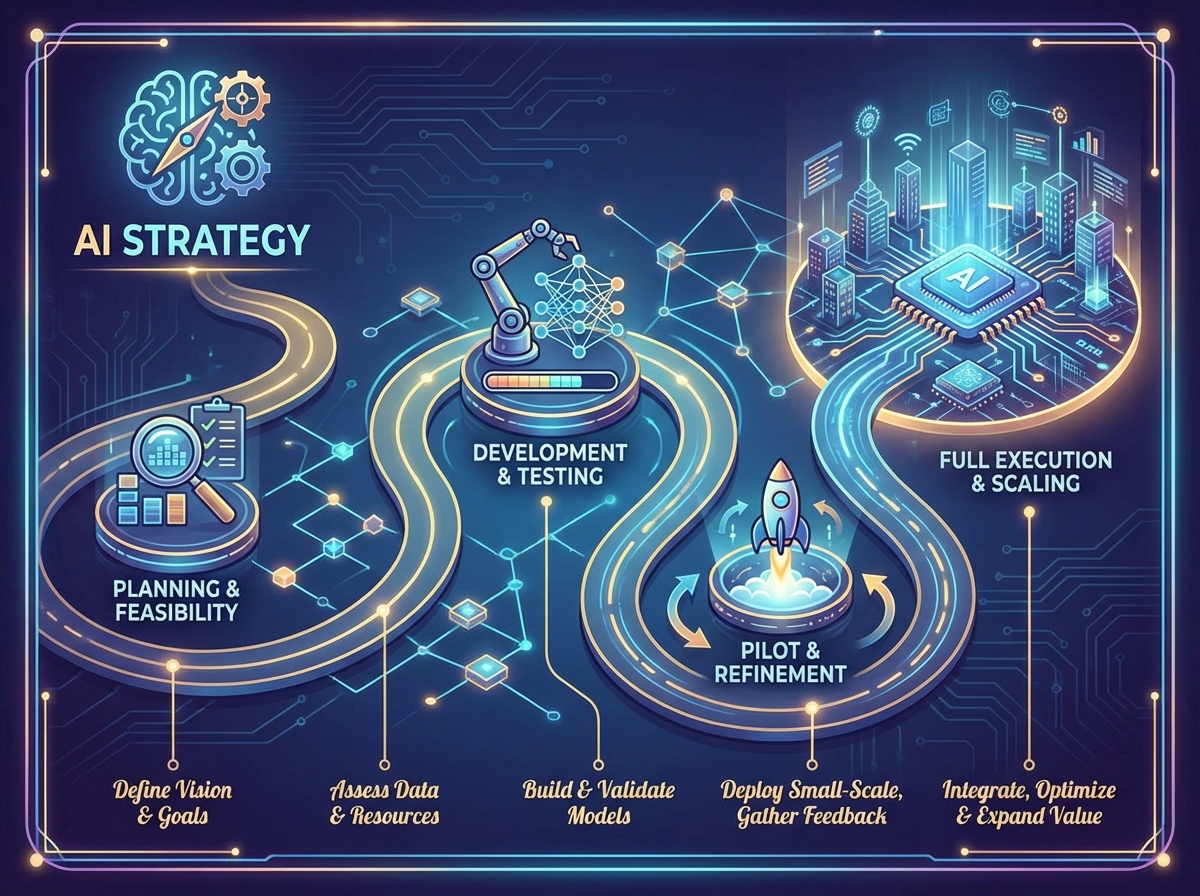
This is where many AI programs stall. Not because the use cases are bad, but because the organisation lacks a portfolio and funding mechanism that matches how AI actually behaves in production: models change after launch, risk and controls are lifecycle-based, and “run” costs are real. If you fund AI like one-off projects, you unintentionally optimise for demos, not adoption, reliability, and governed change.
This lesson gives you a practical way to manage AI work as an outcomes portfolio: how to structure the portfolio, how to fund it, and how to keep governance and decision rights from turning portfolio management into a slow committee.
The portfolio vocabulary that keeps decisions crisp
An AI portfolio system works when everyone shares a few definitions and treats them as “how we run the business,” not as paperwork. The goal is to make trade-offs explicit: value versus capacity, speed versus risk, reuse versus bespoke delivery.
Key terms you’ll use throughout:
-
AI portfolio: The set of AI initiatives (use cases, AI features, and enabling capabilities) managed together with shared prioritisation, capacity planning, and governance.
-
AI outcome: A measurable business result (reduced handle time, fewer defects, higher conversion) that is owned post-launch, not just a model metric.
-
Run vs change: Run is keeping the AI capability safe, monitored, and stable in production (telemetry, incidents, evaluation repeats, vendor model updates). Change is new features, expansions, and material modifications (new data sources, prompt/model swaps).
-
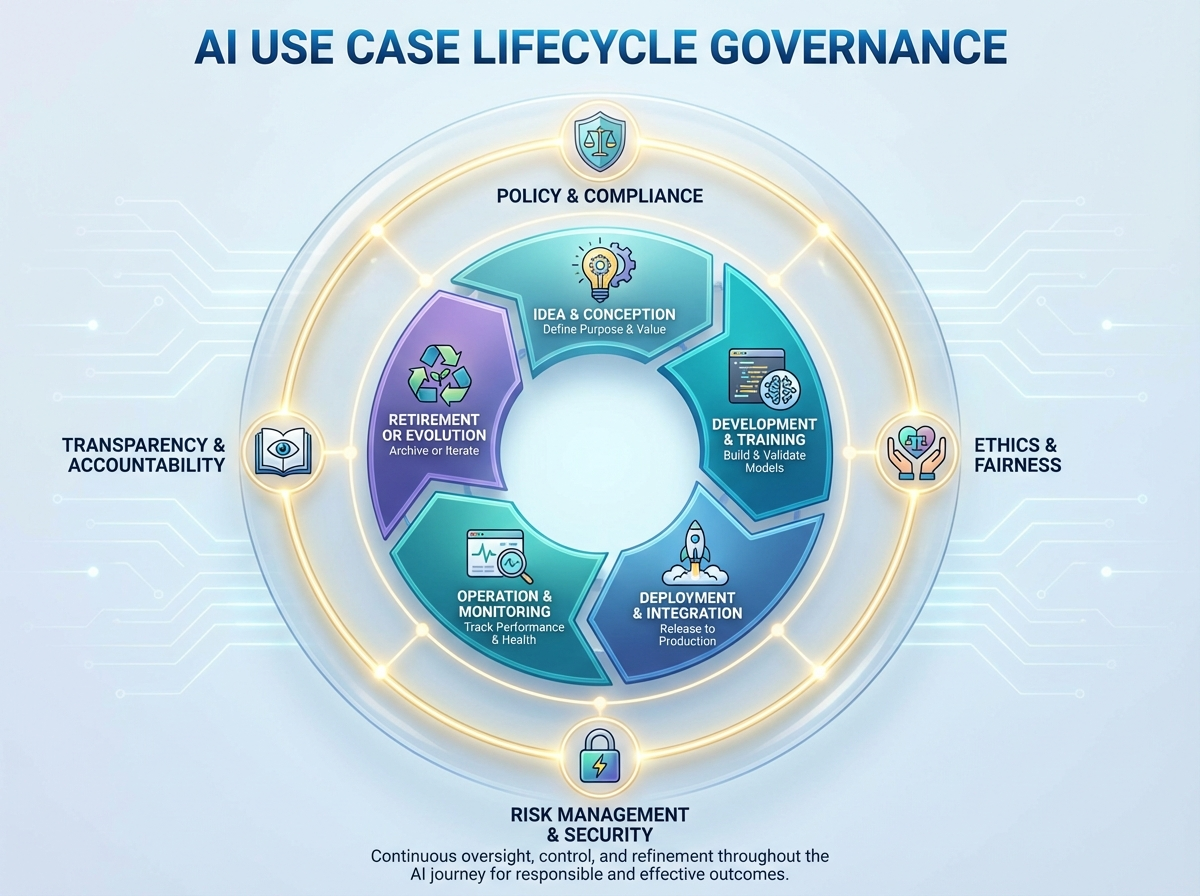
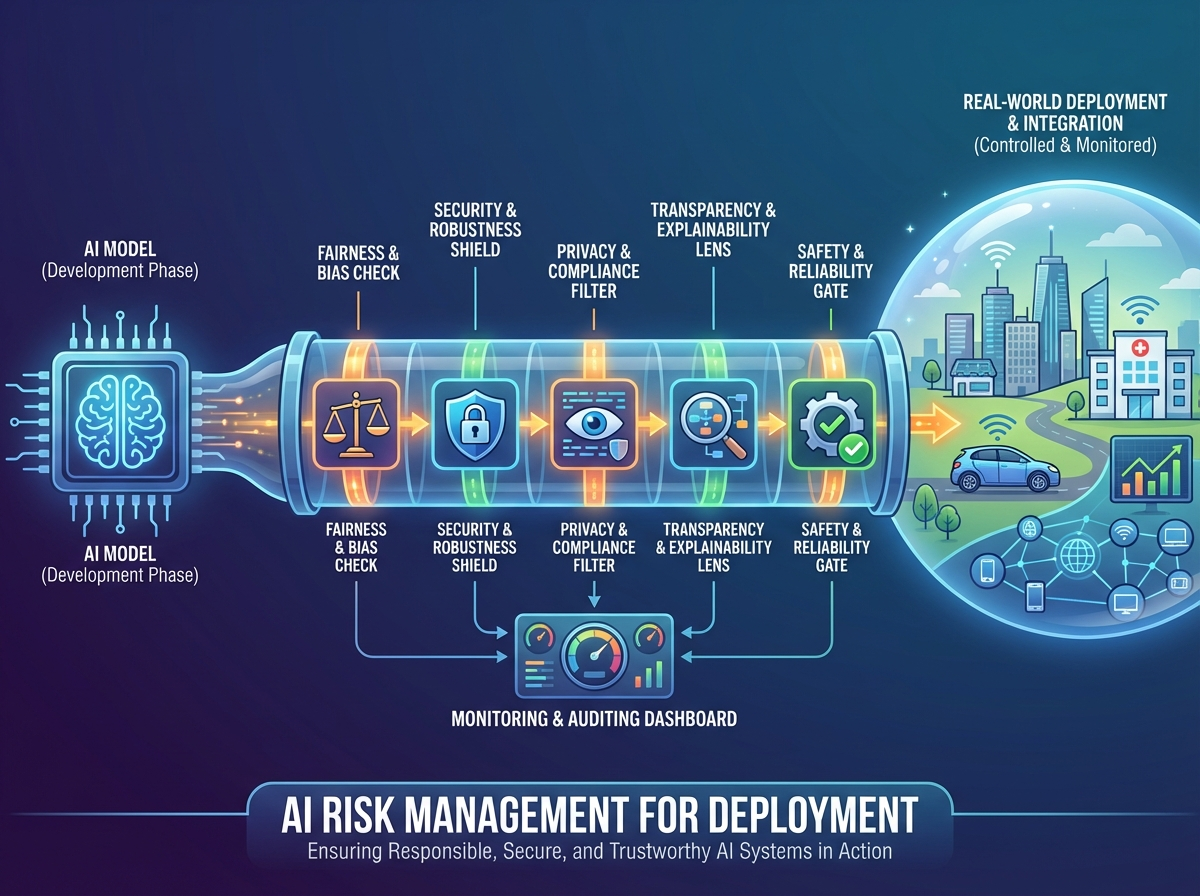
Risk tiering: A way to scale controls and approvals based on impact (privacy exposure, customer harm, regulatory sensitivity). This aligns with the earlier “guardrails + decision rights” approach: higher risk gets tighter non-negotiables and deeper sign-off.
-
Paved roads: Shared platform defaults (logging, registries, evaluation templates, deployment patterns) that make the compliant path the easiest path—critical for scalable portfolios.
A useful analogy is treating AI like a product portfolio with a safety case, not an IT project list. In a product portfolio, you expect ongoing operations, continuous improvement, and sunsetting. In a safety case, you expect evidence: evaluation results, change logs, and monitoring thresholds. When you combine them, funding and prioritisation naturally shift toward initiatives with clear ownership, measurable outcomes, and an auditable path to production.
The practical connection to ways of working is direct. Squads need stable funding to own outcomes and “run.” Platform teams need capacity funded as a reusable accelerator, not as an optional overhead. Risk owners need a predictable engagement model tied to tiers, so governance scales without becoming a queue. Portfolio decisions are where those pieces become coordinated execution rather than parallel activity.
What belongs in an AI portfolio (and what doesn’t)
The most common portfolio mistake is treating every AI effort as the same unit of work. In reality, AI portfolios contain different “asset types” that behave differently economically and operationally. If you mix them without separating decision logic, you either over-govern low-risk experiments or underfund the production reality.
1) Three portfolio lanes that reduce chaos
A practical structure is to run three lanes side-by-side, each with different funding and controls:
-
Lane A: Outcomes (AI products/features): Customer- or employee-facing capabilities owned by product teams or domain squads. These must have adoption metrics, post-launch service ownership, and an explicit “material change” process.
-
Lane B: Enablers (platform + shared capabilities): Logging defaults, model/prompt registries, evaluation harnesses, deployment templates, redaction services, incident tooling. These are “paved roads” that reduce rework and make governance operational.
-
Lane C: Discovery (bounded experiments): Time-boxed proofs and prototypes with explicit exit criteria. The goal is to reduce uncertainty, not to sneak production work through a lighter process.
This separation prevents a classic misconception: that “platform work steals budget from innovation.” In mature AI organisations, platform work is what makes innovation repeatable. It also prevents the opposite misconception: that experiments should be treated like products. Discovery should be cheap, fast, and evidence-seeking; production should be owned, monitored, and governed.
2) Funding should match the lifecycle, not the hype cycle
AI capabilities don’t end at launch. GenAI copilots especially can change behaviour with what looks like a trivial edit—prompt changes, retrieval source updates, or vendor model upgrades. That’s why portfolio governance must treat change control and evaluation as recurring costs. If you don’t fund evaluation reruns, monitoring, and incident response, you get a predictable failure mode: strong pilot results followed by erosion in quality, untracked changes, and risk exposure that shows up during an audit or customer incident.
Another common pitfall is ignoring shared constraints. Data owners, security reviews, and platform pipelines become hidden bottlenecks. Portfolio thinking forces you to ask: “What is the limiting reagent?” Sometimes it’s not money—it’s risk review capacity or data engineering bandwidth. Funding decisions must include these constraints, otherwise the portfolio becomes a wish list and teams compensate with workarounds (shadow tools, inconsistent logging, bypassed registries), which undermines both speed and governance.
3) A portfolio is also a de-duplication machine
When delivery scales, multiple teams often build the same thing: separate evaluation scripts, separate redaction logic, separate prompt versioning, incompatible logging. That fragmentation increases run costs and makes audit evidence incomparable. A portfolio lens lets you spot this early by tracking repeated asks and pulling them into Lane B (enablers) where they become reusable guardrails.
The subtle but important cause-and-effect is this: reusability reduces governance friction. When telemetry and evidence capture are standard by default, risk sign-offs rely less on bespoke explanations and more on comparable artifacts. The organisation moves from “approval by meeting” to “approval by evidence,” which is exactly what scaled decision rights are meant to enable.
How to prioritise AI: outcomes, risk, and capacity—together
Prioritisation breaks when teams rank initiatives only by ROI narratives. AI prioritisation must be multi-dimensional because feasibility, risk tier, and enabling dependencies drive time-to-value and total cost of ownership. A simple scoring model is fine; what matters is that it reflects how AI actually ships and runs.
A decision table that makes trade-offs explicit
Use a lightweight scorecard that forces clarity across business value, delivery feasibility, and governance. Keep it consistent so comparisons are meaningful across squads and business units.
| Dimension | What “good” looks like | What to watch for (portfolio risk) |
|---|---|---|
| Outcome clarity | A named owner, measurable KPI (adoption + business metric), and a baseline to compare against. Success includes post-launch health, not just pilot performance. | Vague benefit statements (“efficiency”), no adoption plan, or success framed only as model accuracy. |
| Lifecycle readiness | Clear plan for monitoring, incident response, and “material change” definitions (what requires re-evaluation and sign-off). Evidence artifacts fit your guardrails (evaluation report, change log). | “Done at launch” mindset, no run ownership, or reliance on ad-hoc checks that won’t scale. |
| Risk tier + controls | Risk tier is declared early; required non-negotiables are known (redaction, logging, approvals). For higher tiers, human fallback and staged rollout are built in. | Teams discover constraints late (privacy, security), causing rework and delays—or worse, risky launches. |
| Dependency on paved roads | Uses standard platform patterns (registry, deployment templates, logging schema). If a new enabler is needed, it’s explicitly funded in Lane B. | “Temporary exceptions” become permanent fragmentation; multiple teams reinvent the same control mechanism. |
| Capacity realism | Includes constraints beyond dev hours: data engineering, risk review bandwidth, platform throughput, SME time. Sequencing reflects actual bottlenecks. | Portfolio overload: many “top priorities,” long queues, and pressure to bypass governance to hit dates. |
This approach reinforces a key governance principle: delegate decisions closest to impact, inside guardrails. Squads can prioritise within their domain, but enterprise-level portfolio decisions should arbitrate shared capacity and non-negotiables. If you don’t, teams compete for scarce platform and risk capacity in unstructured ways, and governance becomes reactive.
A frequent pitfall here is turning the scorecard into a bureaucracy. The cure is to keep it thin and evidence-based: a one-page decision record with links to artifacts (evaluation readiness notes, data access status, risk tier rationale). If the platform makes evidence capture automatic (registries, standard telemetry), the scorecard becomes a fast reading of reality rather than an opinion contest.
[[flowchart-placeholder]]
Funding models that fit AI work (and when each breaks)
Funding is where strategy becomes real. The best portfolio model is the one that aligns incentives with safe, repeatable delivery: it funds outcomes and the enabling system, and it doesn’t punish teams for doing the operational work that makes AI sustainable.
Comparing three workable funding approaches
| Funding model | How it works | Strengths | Failure modes to guard against |
|---|---|---|---|
| Product (squad) funding for outcomes | Persistent squads are funded to own a domain outcome (build + run). Budget includes monitoring, evaluation reruns, and change control. | Strong operational ownership; avoids “central builds, local suffers.” Fits AI as a living feature with post-launch iteration. | Teams may reinvent tooling if platform is weak; portfolio can fragment without minimum non-negotiables and shared telemetry. |
| Platform/enabler funding (paved roads) | A central platform team is funded like a product: SLAs, roadmap, usability, and adoption. It owns non-negotiables (logging schema, registries, deployment templates). | Reduces duplication; increases auditability via built-in evidence capture; accelerates multiple squads at once. | “Platform says no” bottleneck if governance becomes approvals; low adoption if platform is hard to use or slow to evolve. |
| Stage-gated discovery funding (options-based) | Small, time-boxed discovery budgets buy learning. Only initiatives meeting exit criteria (value + feasibility + risk path) get scale funding. | Prevents over-investment in uncertain ideas; makes uncertainty explicit; encourages fast evidence gathering. | If gates are committee-heavy, speed dies; if gates ignore run costs, teams ship pilots that can’t be operated safely. |
A typical misconception is that stage gates are “anti-agile.” They’re not—if you treat them as risk- and evidence-based checkpoints rather than theatre. For AI, gates are especially valuable around moments like data access, evaluation readiness, and material changes, because those points correlate strongly with rework and risk exposure.
Another misconception is that platform gets funded “once” and then becomes a fixed asset. In practice, platform is a living product. New regulations, new vendor model behaviours, and new use-case patterns force evolution. Underfund the platform and you pay later through duplicated effort, inconsistent logs, and slower incident response.
A best practice is to fund run explicitly. If teams must fight for “run budget,” they will deprioritise monitoring, evaluation reruns, and cleanup work—exactly the work that keeps GenAI systems safe as prompts and models evolve. Treat run as non-negotiable capacity, not discretionary spend.
Applied example 1: Retail bank support copilot—funding outcomes without losing control
A retail bank wants a contact-center GenAI assistant that summarises calls, drafts responses, and suggests next-best actions. Multiple teams propose variations, but the portfolio view reveals shared dependencies: redaction before external calls, standard evaluation (groundedness, toxicity, privacy leakage), and audit-ready change logs for prompt updates. The bank separates the work into two lanes: the contact-center squad is funded for the outcome (adoption, handle time reduction, escalation rate), while the platform team is funded for paved roads (logging defaults, prompt registry, evaluation harness, incident tooling).
The prioritisation decision becomes clearer with that split. The squad can move quickly inside guardrails because the platform makes the compliant path easy: every prompt version is registered, evaluations are runnable as a standard suite, and “material changes” require re-running the suite and capturing evidence. Risk owners focus on tier-based non-negotiables and unacceptable failure modes (hallucinated financial advice, leakage of sensitive content) rather than re-approving every small change. The budget supports this reality by funding the recurring costs: monitoring dashboards, staged rollouts, and incident response.
Impact and limitations show up quickly. The bank gets weekly iteration without turning iteration into uncontrolled production drift, because change control is part of the funded operating rhythm. The limitation is coordination overhead: when both platform and squad roadmaps are tight, priorities can clash. The portfolio mechanism resolves this by explicitly tracking which squad outcomes are blocked by which platform enablers, and funding the enabler work as first-class delivery rather than invisible overhead.
Applied example 2: Predictive maintenance across 40 plants—portfolio as a reuse and capacity engine
A manufacturer deploys predictive maintenance models across 40 plants with different sensor quality and workflows. Without a portfolio approach, each plant would request bespoke pipelines, dashboards, and model monitoring, creating tool sprawl and incomparable performance metrics. The organisation instead funds a central platform capability as Lane B: standard ingestion patterns, model registry usage, monitoring defaults, and deployment templates. It also funds regional analytics squads as Lane A to tailor models and integrate them into maintenance workflows.
Step by step, the portfolio prevents predictable bottlenecks. First, the platform team defines non-negotiables that make cross-plant operations possible: a consistent logging schema, minimum dashboards, and incident tooling so outages and drifts are triaged consistently. Second, each plant initiative must meet a lightweight readiness bar before deployment: documented evaluation results, data quality thresholds, and a rollback plan. Third, the portfolio explicitly allocates scarce review capacity—data owner approvals, security engagement, and SME time—so “40 parallel priorities” doesn’t collapse into queue chaos.
The benefits are tangible: reuse reduces build time per plant, leadership gets comparable indicators across sites, and incident response improves because telemetry is standard. The limitation is adoption risk: if the platform is slow or hard to use, plants bypass it. The portfolio mitigates this by treating exceptions as time-bound and visible (documented rationale plus a plan to return to paved roads), preventing temporary deviations from becoming permanent fragmentation.
Closing the loop: portfolio decisions that reinforce speed and governance
Portfolio and funding are not separate from governance; they are how governance becomes real. If you fund only “new build,” you incentivise risky launches and unpaid operational debt. If you fund only central controls, you create bottlenecks and slow delivery. The balance comes from funding outcomes and paved roads together, with risk-tiered guardrails and clear decision rights at lifecycle moments.
Key takeaways:
-
Separate your portfolio into outcomes, enablers, and discovery so each lane has the right funding logic and governance burden.
-
Prioritise with a multi-dimensional view (outcomes, lifecycle readiness, risk tier, platform dependencies, capacity realism), not ROI stories alone.
-
Fund run explicitly—monitoring, evaluation reruns, incident response, and material change control are the cost of sustainable AI.
-
Use paved roads to reduce governance friction by making evidence capture and non-negotiables default rather than negotiated each time.
A checklist you can trust
-
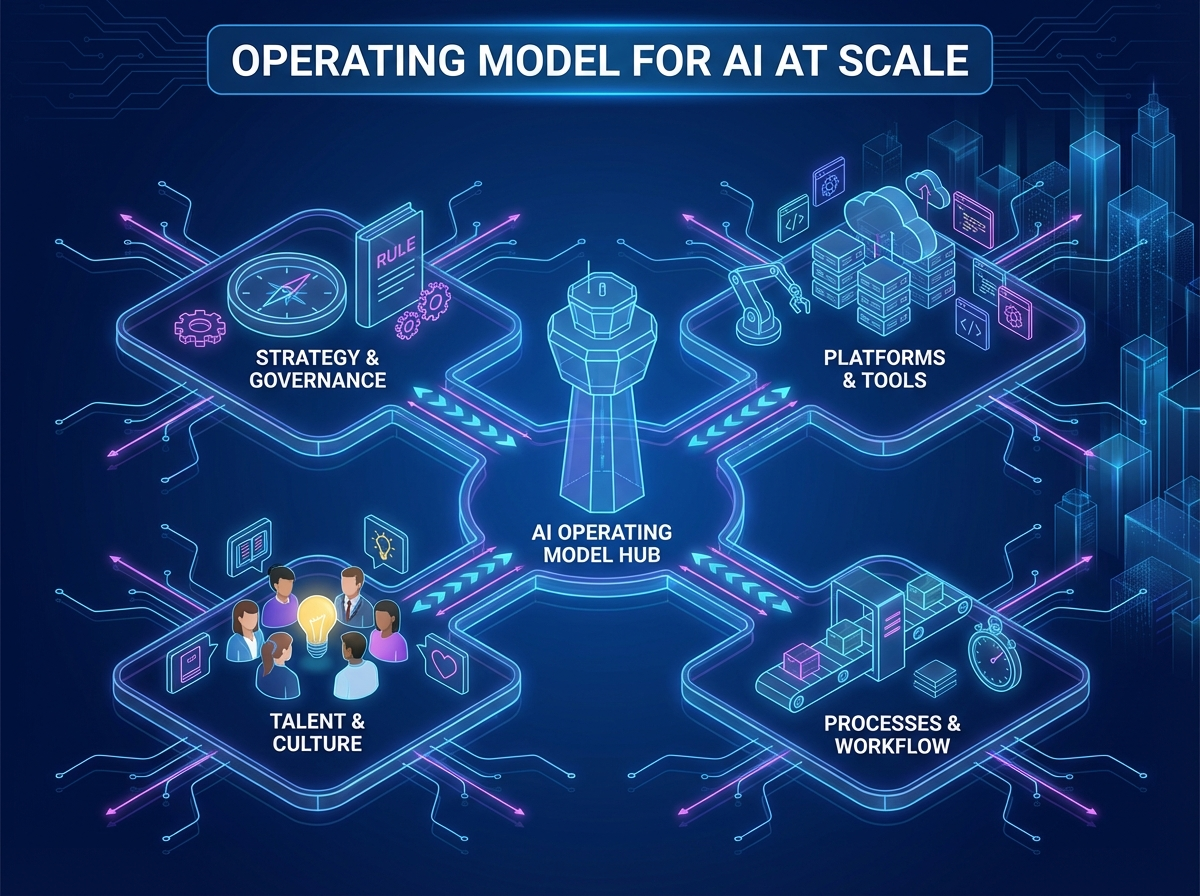
Scaling AI requires an operating model that covers selection, build, deployment, governance, continuous improvement, and retirement—otherwise you get either queues (over-centralisation) or fragmentation (over-decentralisation).
-
Decision rights and risk-tiered guardrails keep teams fast and accountable by defining who can approve value, technical changes, risk controls, and data access at key lifecycle moments.
-
Portfolio and funding make AI outcomes repeatable when they separate outcomes, enablers, and discovery, and when they fund run + change rather than rewarding demos over durability.
With this combination, AI stops being a collection of promising pilots and becomes a managed system that can scale—measurably, safely, and without turning governance into a delivery tax.