When AI ships faster than accountability
A product team launches an AI feature that auto-summarises customer calls for sales reps. Within two weeks, complaints spike: some summaries invent details (“hallucinations”), a few include sensitive personal data, and one customer asks for an explanation of why their account was flagged “high churn risk.” The team thought this was “just a model issue,” but legal asks about privacy and records retention, security wants to know where call data flows, and the business owner wants to keep the feature live because it’s boosting productivity.
This is the moment most organisations discover a hard truth: AI risk isn’t only technical. It’s also decision rights, sign-offs, evidence, and clear accountability. Without governance, every incident becomes a scramble—teams debate who owns what, controls are inconsistent, and leadership can’t confidently scale AI beyond pilots.
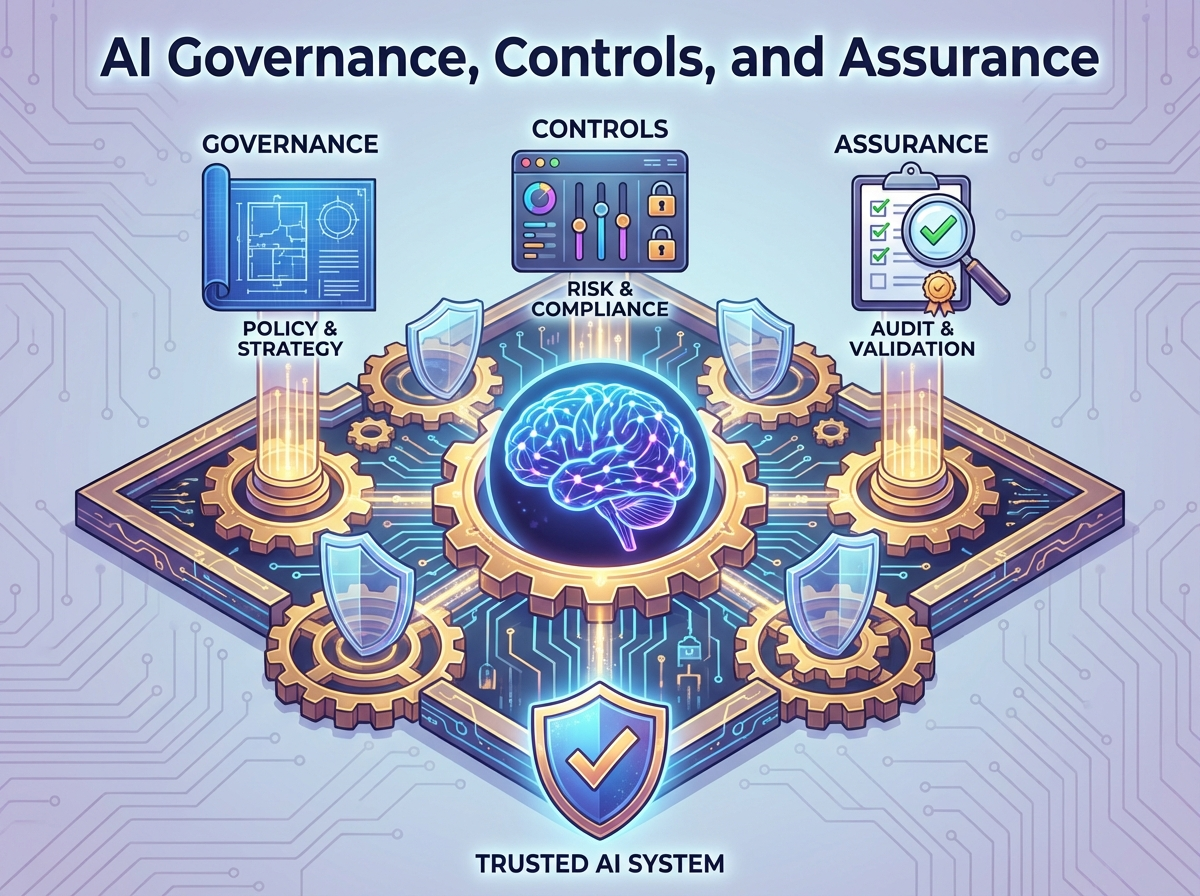
This lesson gives you a practical way to structure that accountability: governance frameworks (how decisions and oversight work) and committees (who makes and reviews those decisions at the right level).
The simplest useful meaning of “AI governance”
AI governance is the set of decision-making structures, policies, processes, and oversight mechanisms that ensure AI systems are developed and used in line with the organisation’s goals, risk appetite, legal obligations, and ethical commitments. It is not a single document or a single committee; it’s a system that makes “the right thing” repeatable.
Key terms you’ll use throughout this lesson:
-
Decision rights: who can approve, block, or require changes to an AI use case.
-
Accountability: who is answerable when something goes wrong (not just who built it).
-
Oversight: independent review that can challenge assumptions and require evidence.
-
Controls: concrete measures that reduce risk (policies, checks, monitoring, human review).
-
Risk appetite: what level of residual risk leadership is willing to accept, and where.
A helpful analogy is financial governance. Finance doesn’t stop teams from spending money; it creates budgets, approval thresholds, audit trails, and segregation of duties so spending aligns with strategy and stays compliant. AI governance does the same for models, data, and automated decisions—so scaling does not multiply unmanaged risk.
Frameworks vs committees: how they fit together
A governance framework is the blueprint: principles, roles, policies, processes, and artifacts. Committees are the operating bodies that apply the framework: they review, approve, escalate, and enforce it. When these two are confused, organisations either create “committees with no levers” (talk shops) or “policies with no adoption” (shelfware).
Here’s a practical comparison so you can keep them distinct.
| Dimension | Governance framework | Governance committees |
|---|---|---|
| Purpose | Defines how governance works end-to-end: roles, policies, approvals, evidence, escalation paths. | Provides human decision points: review, challenge, approve, reject, and prioritise. |
| What it produces | Policies, standards, risk tiers, required documentation, lifecycle gates, monitoring expectations. | Meeting decisions, approvals with conditions, exception rulings, escalation records, portfolio alignment. |
| Time horizon | Medium-to-long term: designed to be stable and scalable across use cases. | Ongoing operational cadence: weekly/monthly review and incident-driven decisions. |
| Failure mode | Overly abstract; teams can’t translate it into build/run steps. | Either rubber-stamping (too lax) or bottlenecking delivery (too strict). |
| Success test | Teams can ship AI with consistent evidence and clear accountability. | Decisions are timely, documented, and enforceable with follow-through. |
Good governance feels invisible when everything is working: teams know what artifacts to produce, what approvals they need, and how to escalate. Great governance becomes obvious only when risk spikes—because incidents are handled quickly with clear owners and traceable decisions.
Designing governance that actually scales (not just controls)
1) A risk-tiered governance model (one size doesn’t fit all)
A common misconception is that “all AI needs the same governance.” In practice, governance must be risk-tiered, or you get one of two failures: high-risk systems slip through with light review, or low-risk automation is forced through heavyweight approvals that kill adoption.
A risk-tiered model classifies AI use cases by impact, sensitivity, and autonomy, then sets graduated requirements. For example, an internal tool that drafts meeting notes has very different consequences than a model that recommends credit limits or flags fraud. Your tiers should map to required evidence: data handling proof, model evaluation results, human oversight design, and monitoring plans. The goal is not bureaucracy; it’s proportional assurance.
Best practices that make risk-tiering workable:
-
Define clear triggers for higher tiers: regulated decisions, vulnerable populations, biometrics, safety-critical contexts, or processing sensitive data.
-
Require stricter review as autonomy increases: “assist” tools differ from “decide” systems.
-
Use minimum required artifacts per tier: concise, standard templates beat long narratives.
Common pitfalls:
-
Vague tiers (“low/medium/high” with no criteria) leading to inconsistent classification and political debates.
-
Over-weighting novelty (“LLMs are always high risk”) instead of use context (data + decision impact + controls).
-
Treating tiering as a one-time form rather than something that updates as the system evolves, gains users, or changes data sources.
A useful principle: govern the decision, not the model. The exact algorithm matters, but what matters more is how outputs are used, by whom, with what recourse when wrong.
2) Lifecycle governance: gates, artifacts, and “evidence over intent”
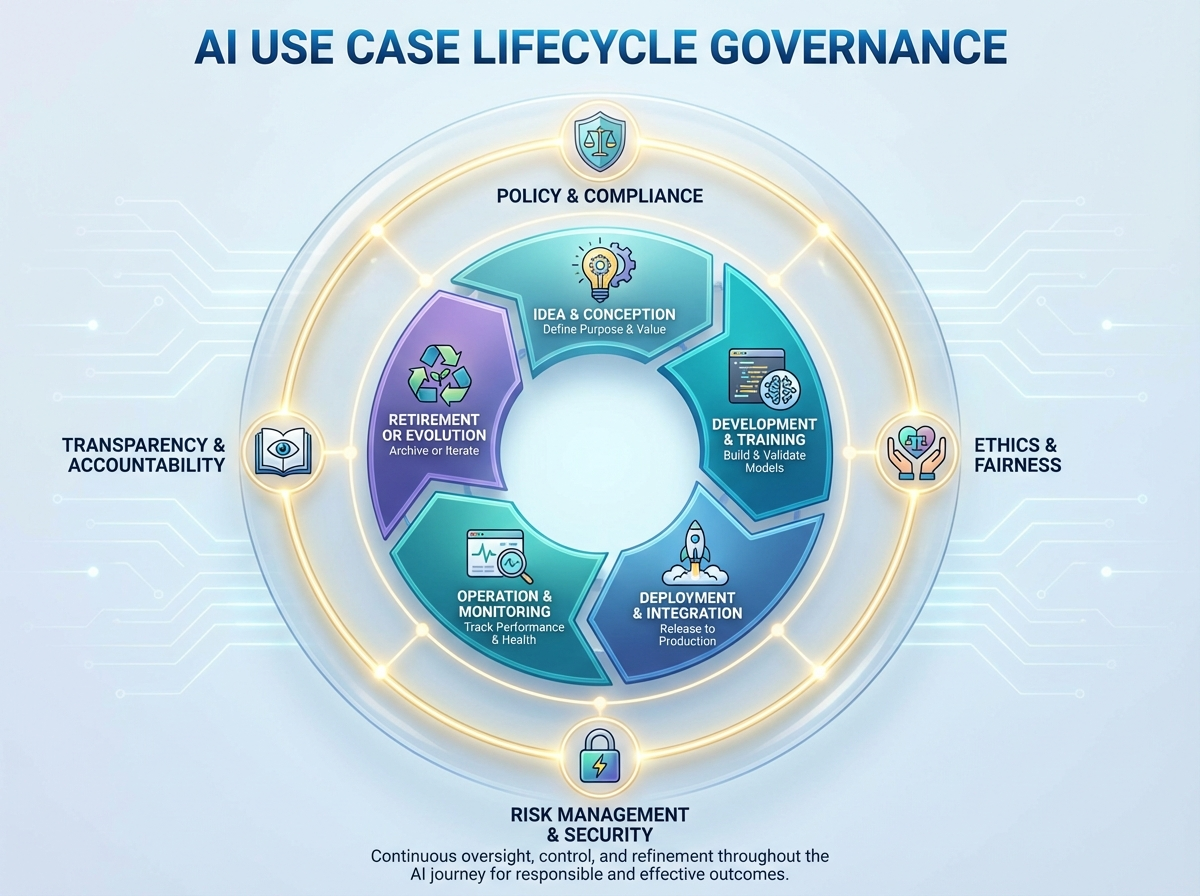
AI governance fails when it is a policy-only approach (“be fair,” “be secure”) without build/run integration. Lifecycle governance makes governance real by introducing gates and required artifacts at key moments: intake, design, pre-launch, and post-launch operations. Each gate asks for evidence appropriate to the risk tier.
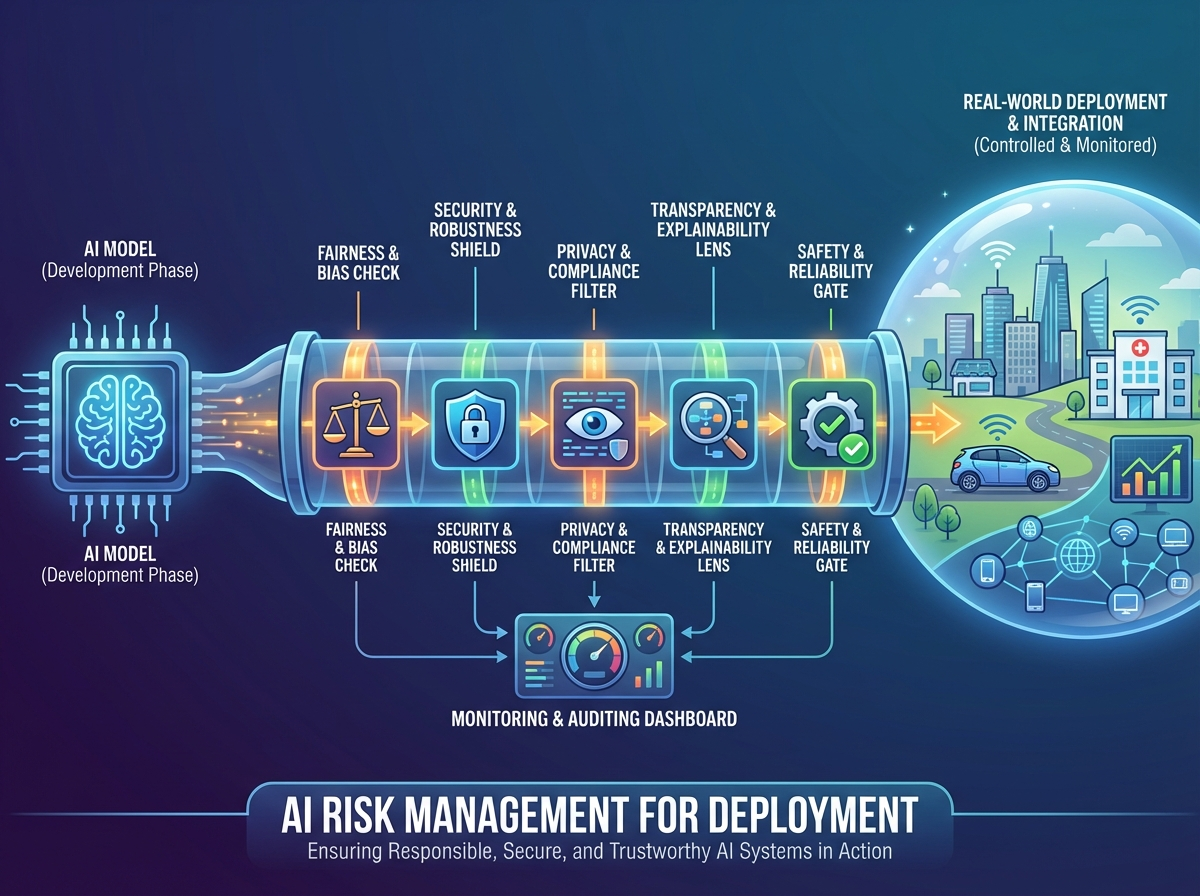
At intake, governance clarifies ownership, objectives, and whether the use case should exist at all. In design, governance focuses on data provenance, consent, and user experience controls (e.g., disclosures and feedback loops). Pre-launch governance checks evaluation quality, security posture, and readiness to monitor. Post-launch governance enforces incident response, drift monitoring, and periodic reviews—because many AI failures emerge after real users and messy data hit the system.
Best practices:
-
Prefer standard evidence packs: a one-page use-case brief, a risk assessment, evaluation summary, and monitoring plan are often more enforceable than a 40-page report.
-
Embed gates into delivery workflows (e.g., “no production deployment without ticketed approval and artifacts attached”).
-
Treat governance artifacts as living documents with versioning, not one-time compliance paperwork.
Common pitfalls and misconceptions:
-
“We validated it once, so we’re done.” Models degrade; prompts change; data shifts; user behavior evolves.
-
“Monitoring is just model metrics.” Real monitoring includes business outcomes, user complaints, escalation rates, and operational incidents.
-
Confusing documentation with control. Documentation is only useful if it is reviewed, challenged, and connected to enforceable decisions.
Strong lifecycle governance creates an audit trail of why the system exists, what risks were accepted, and what safeguards are in place—so leadership can scale with confidence rather than hope.
3) Committee design: decision rights, cadence, and escalation
Committees are often created reactively after an incident: “We need an AI ethics board.” Then nothing changes because the committee has no clear authority or because it meets irregularly and reviews everything at the wrong depth. A well-designed committee structure is explicit about what decisions it makes, what it delegates, and how it escalates.
At intermediate maturity, many organisations use a two-layer structure:
-
An AI Steering Committee (or AI Governance Council) set at leadership level to set policy direction, approve risk appetite boundaries, prioritise strategic AI investments, and resolve cross-functional conflicts.
-
An AI Risk Review Board (or Model Risk/AI Review Committee) focused on reviewing specific use cases and gating deployments based on evidence and tiered requirements.
The key is decision scope. Steering should not debate prompt wording; the review board should not redefine corporate risk appetite every week. Both should have written charters, membership that reflects actual risk (legal, security, privacy, compliance, product, data/ML, and business owners), and a pre-defined SLA for decisions. Otherwise, delivery teams either bypass governance or freeze while waiting.
Best practices:
-
Ensure the business owner is accountable for the use case; governance is not a way to outsource responsibility to legal or data science.
-
Use conditional approvals (“approved if you add human review for tier-3 decisions and strengthen monitoring”) rather than binary yes/no when appropriate.
-
Create a formal exception process: if the business wants to accept higher residual risk, it requires documented sign-off at the right level.
Common pitfalls:
-
Committees that become “rubber stamps” because they lack time, expertise, or the ability to say “no.”
-
Committees that become bottlenecks because they review every low-risk use case in full detail.
-
Over-representation of one function (e.g., only technical leaders), leading to blind spots in privacy, consumer protection, or operational risk.
Governance committees work when they are not just oversight bodies—they are decision engines with authority, documentation standards, and clear escalation.
4) RACI and “three lines” thinking: making ownership unambiguous
AI governance becomes operational when everyone can answer: Who owns the model? Who owns the outcome? Who audits the evidence? A RACI (Responsible, Accountable, Consulted, Informed) is a simple tool, but it prevents the most common post-incident chaos: “I thought you were monitoring it.”
Many organisations adapt the “three lines” concept from risk management:
-
First line: teams that build and operate AI (product, engineering, data science). They own day-to-day risk management and controls.
-
Second line: risk/compliance/privacy/security functions that set standards, challenge, and provide oversight.
-
Third line: internal audit (or equivalent independent assurance) that tests whether governance is working.
This separation matters because it reduces conflicts of interest. The same team that is rewarded for shipping faster should not be the only party deciding that evaluations are “good enough.” At the same time, second-line oversight must be practical: it should define what “good” looks like and review evidence, not redesign the product.
Best practices:
-
Make Accountable roles few and explicit: each use case should have a single accountable business owner.
-
Define what “Responsible” includes: evaluation, documentation, monitoring, incident response, vendor management.
-
Give second line the ability to block or escalate when minimum standards aren’t met.
Misconceptions to correct:
-
“We have an AI team, so they’re accountable.” The AI/ML team is typically responsible for building; accountability must sit with the business owner who benefits from the decision.
-
“Legal approved it, so it’s safe.” Legal review is necessary but not sufficient; operational monitoring and security controls matter just as much.
-
“Audit is governance.” Audit provides assurance; governance is the day-to-day decision system that audit examines.
Clear RACI plus “three lines” separation turns governance from a set of meetings into an operating model.
[[flowchart-placeholder]]
Two real-world governance setups in action
Example 1: A bank deploying an LLM assistant for customer service agents
A retail bank wants an LLM tool that drafts responses for call-center agents and suggests next-best actions. The bank classifies it as higher than “low risk” because it touches account data, could create misleading advice, and affects customer outcomes. Governance begins with intake: a business owner in customer operations is accountable, while data/ML is responsible for model behavior, and security/privacy are consulted for data flows and retention.
At the design gate, the AI Risk Review Board requires evidence that the tool is assistive (agents remain the final decision-maker), plus a clear policy: the assistant must not generate binding commitments or specific financial advice without scripted approval paths. The board also asks for guardrails: retrieval from approved knowledge sources, redaction of sensitive data in prompts/logs, and UX disclosures that the text is machine-generated. These conditions are recorded as an approval-with-constraints, not a vague recommendation.
Pre-launch, the committee reviews evaluation results focused on failure modes that matter: incorrect fees, wrong eligibility statements, and fabrication of policy. Post-launch, governance requires monitoring beyond model metrics: complaint tags (“misleading info”), override rates (how often agents delete drafts), and incident response triggers (e.g., repeated harmful outputs). The benefit is speed with confidence: the bank ships a productivity booster while keeping decision authority with humans and maintaining an evidence trail. The limitation is ongoing operational load—someone must own monitoring and periodic reviews, or the risk will silently return as policies and products change.
Example 2: A retailer using AI for dynamic pricing and demand forecasting
A retailer deploys ML models for demand forecasting and uses outputs to recommend price changes. This use case appears “internal,” but governance treats it as impactful because it can drive unfair outcomes, regulatory scrutiny (depending on market), and reputational risk if pricing appears exploitative. The AI Steering Committee sets boundaries: pricing changes must comply with consumer protection expectations, and sensitive segments (e.g., essential goods) have tighter constraints.
The AI Risk Review Board defines decision rights and autonomy: the system can recommend prices, but automated execution is limited to low-risk categories and capped percentage changes. For higher-risk categories, a pricing manager must approve changes, and the system must provide reason codes (drivers like inventory level, seasonality, competitor index) to support review. Governance also requires documentation of training data, feature sources, and a plan to detect drift—because promotions, supply shocks, and competitor behavior can break assumptions quickly.
After launch, monitoring focuses on business metrics (margin, stockouts) and governance metrics (frequency of cap hits, human overrides, abnormal regional anomalies). When a sudden price spike occurs due to data feed errors, incident handling is clearer: first line rolls back price updates, second line reviews root cause and control gaps, and the Steering Committee decides whether to tighten autonomy or add new approval thresholds. The benefit is resilient scaling: the retailer gets speed where safe and friction where the consequences justify it. The limitation is that governance must be tuned carefully; overly conservative thresholds can erase the value of automation.
Pulling it together: what “good” looks like
Governance frameworks and committees are successful when they make three things consistently true:
-
Decisions are explicit: tiering, approvals, exceptions, and risk acceptance are documented and traceable.
-
Ownership is clear: business accountability, engineering responsibility, independent oversight, and auditability are designed in.
-
Controls are proportional: governance gets stricter as impact, sensitivity, and autonomy increase—without choking low-risk use cases.
If you remember one guiding idea, make it this: AI governance is an operating system for accountability. It should help teams ship valuable AI quickly while protecting customers, the business, and employees through repeatable, evidence-based decisions.
Now that the foundation is in place, we'll move into Control Design: Prevent/Detect/Correct [35 minutes].