When an AI use case “works”… and still becomes a company risk
A product team launches an AI assistant to speed up customer support. Early metrics look great: average handle time drops, CSAT rises, and the backlog shrinks. Two months later, legal flags that the assistant sometimes paraphrases customer data into places it shouldn’t, security finds that a vendor integration logs prompts in plaintext, and finance notices refunds increasing because the model confidently suggested the wrong policy. The model didn’t “fail” in the lab—it failed in the organization.
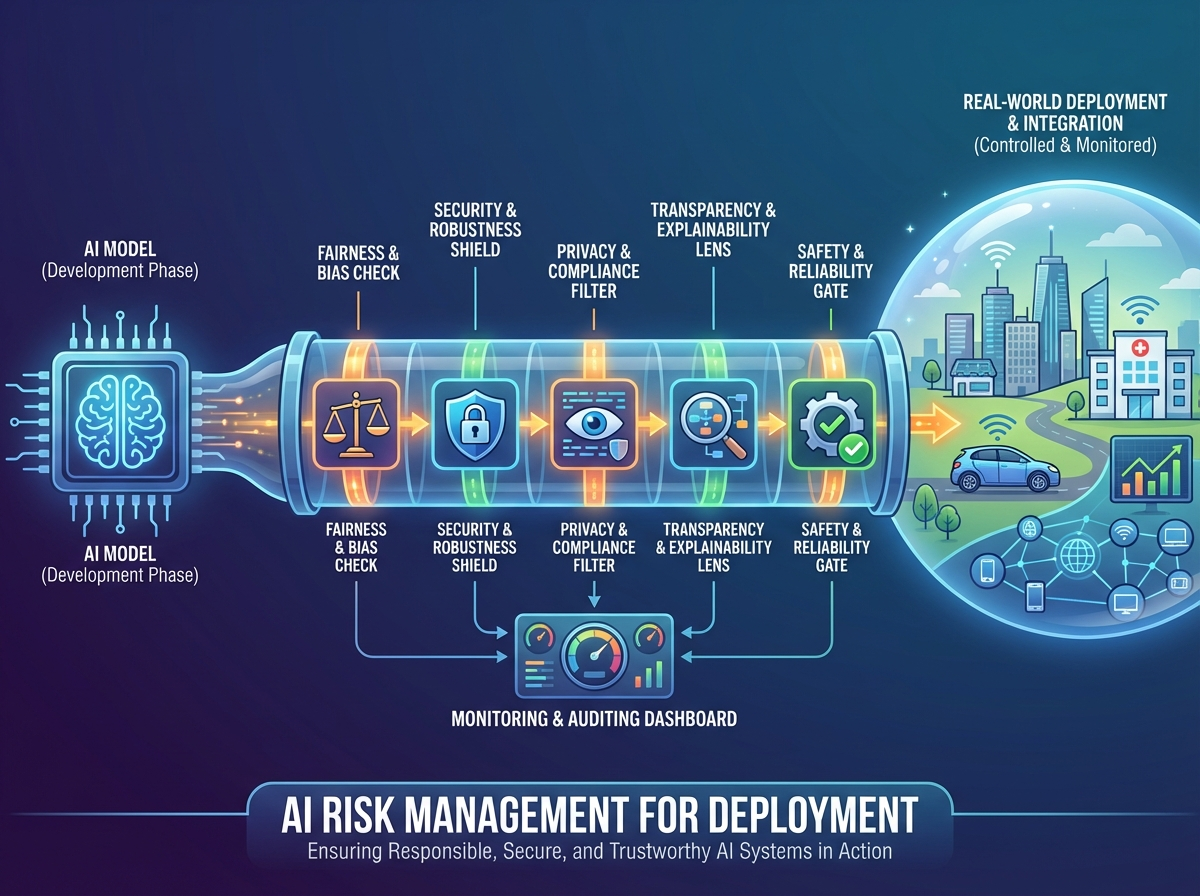
This is why risk categories matter. AI deployment creates multiple kinds of risk at once, and they often show up in different parts of the business (compliance, engineering, operations, brand) at different times. If you only look for “model accuracy” issues, you miss the more common outcomes: unintended data exposure, broken controls, regulatory non-compliance, or business process failures.
In this lesson, you’ll learn a practical way to categorize AI deployment risks so you can assign ownership, choose the right controls, and communicate clearly with executives. The goal is not to eliminate risk; it’s to make risk visible, comparable, and governable across your AI portfolio.
A shared language: what “risk” means in AI deployment
Risk is the combination of (1) the chance something bad happens and (2) the size of the impact if it does. In AI, that “something bad” can come from the model, the data, the surrounding system, the people using it, or the environment it operates in. A helpful mental shift is to treat AI not as a feature, but as a socio-technical system: software + data + policies + humans + vendors + workflows.
A few key terms you’ll use throughout governance discussions:
-
Hazard: a source of potential harm (e.g., “model can produce fabricated answers”).
-
Failure mode: how the hazard shows up in reality (e.g., “agent posts incorrect refund policy with high confidence”).
-
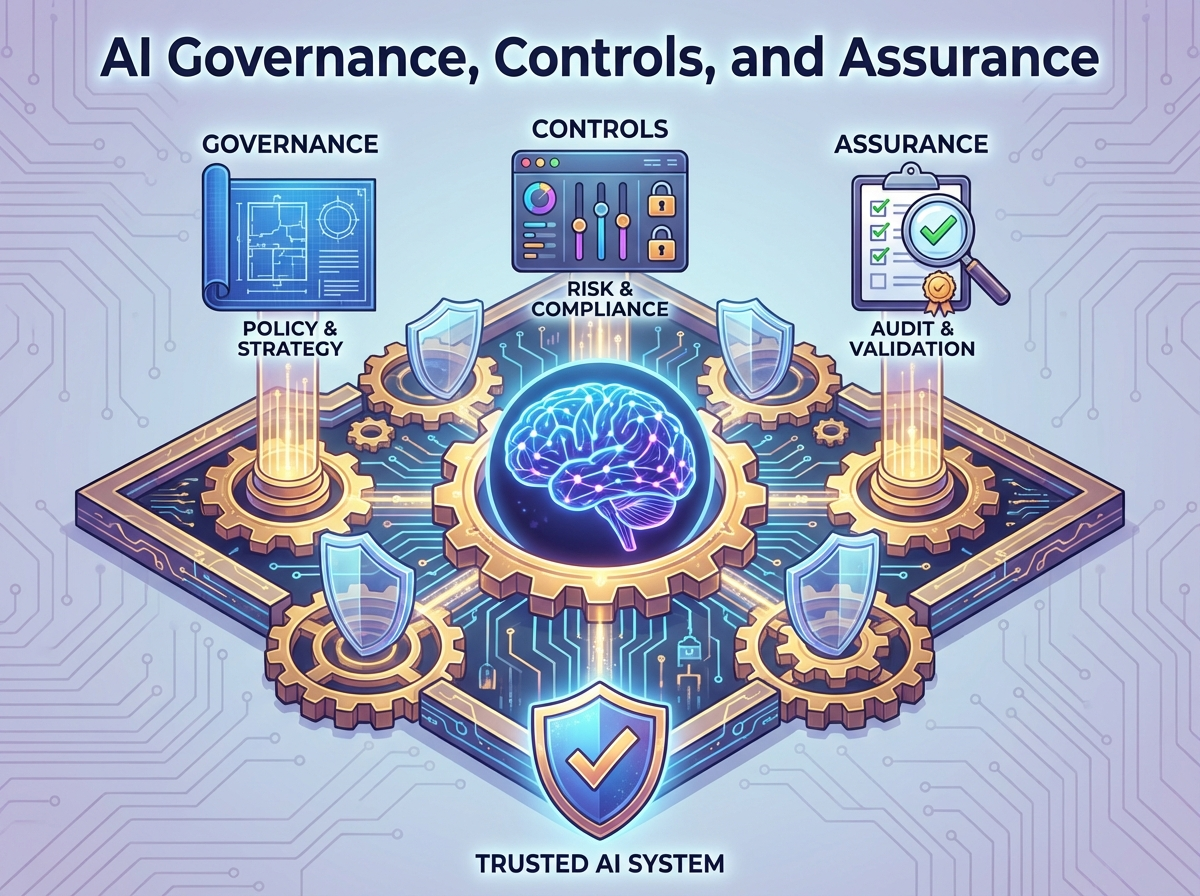
Control: something that prevents, detects, or limits harm (e.g., “human review for refunds above $X”, “blocked topics list”, “audit logs”).
-
Residual risk: what remains after controls are in place (e.g., “rare edge cases still slip through”).
-
Risk appetite: what the organization is willing to accept (e.g., “no tolerance for PII leakage; moderate tolerance for minor tone errors”).
Two underlying principles keep the rest of this lesson grounded:
- Most AI risk is deployment risk, not training risk. Even a well-evaluated model becomes risky when connected to real data, real users, and real business processes.
- Risk categories are mainly for coordination. The point of categorization is to route issues to the right owners, with the right evidence, using the right mitigations—not to create taxonomy theater.
A useful analogy is aviation. Plane safety isn’t only “engine quality.” It’s maintenance processes, pilot training, air-traffic procedures, supplier parts, weather, and incident reporting. AI safety and governance work the same way: the model is only one element in a larger system.
The main risk categories you need to manage (and why they fail in practice)
Data risk: when information handling becomes the incident
Data risk covers harms caused by how data is collected, processed, stored, shared, and used across the AI lifecycle. In practice, this is where many AI incidents begin: a well-meaning team connects a model to sensitive sources, logs too much, retains too long, or exposes data through outputs. Data risk includes privacy breaches, confidentiality leaks, data residency violations, and IP exposure. It also includes “quiet” failures, like using unlicensed datasets or mixing customer data across tenants in ways that violate contracts.
Cause-and-effect is usually straightforward: more connectivity and more automation increases the chance that data flows in ways humans don’t anticipate. Prompt-based systems amplify this because inputs are unstructured and can contain sensitive data accidentally (users paste IDs, contracts, health info), while outputs can inadvertently reveal it (model echoes content, summarizes hidden fields, or hallucinates personal details that look real). Data risk also grows when you introduce vendors—each vendor adds another storage layer, another retention policy, and another breach surface.
Best practices bias toward defaults that assume mistakes will happen. Strong programs build data minimization into designs (only retrieve what’s needed, only store what’s needed), enforce classification-based controls (PII, PCI, PHI, trade secrets), and implement segmentation (tenant isolation, environment separation). They also require contractual clarity with vendors: retention windows, usage limitations (no training on your data unless explicitly agreed), breach notification timelines, and auditability.
Common pitfalls and misconceptions repeatedly show up:
-
Pitfall: treating prompts and model outputs as “not really data.” Prompts are data; outputs may contain data; both need policy and logging discipline.
-
Pitfall: assuming redaction is enough. Redaction helps, but linkability and re-identification risks remain, especially when outputs combine multiple fields.
-
Misconception: “We don’t store data, so we’re safe.” Data can be stored by clients, proxies, observability tools, caches, and vendors even if your core app doesn’t persist it.
Security risk: when the AI system becomes a new attack surface
Security risk focuses on adversarial or unauthorized actions against AI components and the broader system: model endpoints, retrieval layers, data connectors, orchestration tools, and user interfaces. AI changes security because it introduces non-deterministic behavior and new kinds of inputs that can be weaponized. For example, prompt injection can trick a system into ignoring rules, exfiltrating secrets, or calling tools in unintended ways. Even without sophisticated attackers, ordinary users can stumble into harmful behaviors by experimenting with prompts.
A common chain is: attacker finds a way to influence the prompt → model produces an unsafe tool call or discloses hidden instructions → system executes or reveals something valuable. This is especially dangerous in “agentic” setups where the model can call APIs, send emails, modify tickets, or query internal systems. Security risk also includes classic issues like weak auth, over-permissive service accounts, and insecure logging—AI simply increases the blast radius by making it easier to trigger actions at scale.
Best practices treat AI like any other production system, plus a few AI-specific controls. You still need least privilege, network boundaries, secrets management, and continuous monitoring, but you also need input validation for untrusted text, tool gating, allowlists, and policy enforcement layers outside the model. Critical actions should require deterministic checks (e.g., “refund > $100 requires human approval”) rather than trusting the model’s “reasoning.”
Pitfalls and misconceptions:
-
Pitfall: relying on “the model will follow the system prompt.” System prompts are not security boundaries; enforce rules in code and infrastructure.
-
Pitfall: giving tools broad access “for convenience.” Over-scoped tool permissions are a common root cause of high-impact incidents.
-
Misconception: “We’re not a target.” Automated attacks and opportunistic probing hit everyone once an endpoint is public or connected to valuable data.
Legal and regulatory risk: when the deployment violates rules (even unintentionally)
Legal and regulatory risk is the set of exposures from laws, regulations, contractual commitments, and standards that apply to your AI use case. This includes privacy law obligations (consent, purpose limitation, deletion), sector regulations (financial services, healthcare), consumer protection (misleading claims), employment law (automated decision-making), and product liability. It also includes intellectual property risks such as copyright disputes around training data, output ownership ambiguity, and license violations in datasets or model components.
What makes this category tricky is that AI deployments often create new “processing activities” that weren’t in the original business process. A simple chatbot can become an automated decision support system; an internal summarizer can become a records system if outputs are stored and used for compliance decisions. Regulatory expectations also tend to focus on governance evidence: not just that you did the right thing, but that you can prove you did (documentation, audits, traceability, change control).
Best practices start with mapping: what laws apply, what data types are involved, what jurisdictions are in play, and what the model actually does in the workflow. Effective teams implement policy-by-design mechanisms: notices and consent where required, data processing agreements with vendors, retention and deletion workflows, and documented decision logic for high-stakes uses. They also align marketing and product claims: “AI-assisted” vs “fully automated” matters legally when someone relies on the output.
Pitfalls and misconceptions:
-
Pitfall: treating compliance as a sign-off at launch. Model updates, prompt changes, new connectors, and new user groups can change the legal posture.
-
Pitfall: assuming internal tools are exempt. Internal deployments can still trigger privacy and labor obligations.
-
Misconception: “If the vendor is compliant, we’re compliant.” Vendor compliance helps, but accountability and due diligence still sit with the deploying organization.
Operational and business risk: when the workflow breaks, not the model
Operational risk covers failures in business processes, service delivery, and organizational execution caused by AI integration. AI systems can introduce brittleness: sudden output changes, inconsistent performance across user segments, unclear handoffs between humans and automation, and failure cascades when downstream systems treat model outputs as facts. Many organizations discover that the model is “good enough” while the process around it is what creates harm: agents over-trust suggestions, exception handling is missing, or escalation paths are unclear.
Cause-and-effect here is subtle. AI often replaces a deterministic step with a probabilistic one; that changes the required controls. If operations were built around predictable outputs, adding AI can create noisy inputs downstream, raising rework, customer dissatisfaction, and cost. Operational risk also includes vendor dependency (outages, pricing shifts, API changes), capacity planning (latency spikes), and incident response readiness (can you roll back prompts, disable tools, or isolate a tenant quickly?).
Best practices focus on reliability engineering plus “human in the loop” design that is intentional, not accidental. Strong deployments define service-level objectives for AI behavior (latency, refusal rates, escalation rates), implement guardrails (confidence thresholds, restricted actions), and build the workflow so humans can correct outputs efficiently. They also invest in observability that captures not just system uptime but AI-specific signals: top failure modes, high-risk content triggers, and where users override the system.
Pitfalls and misconceptions:
-
Pitfall: launching without a rollback plan for prompts, retrieval configurations, or model versions.
-
Pitfall: measuring only productivity wins. You also need measures for rework, complaints, error costs, and time-to-detect.
-
Misconception: “If accuracy is high, operations will be fine.” A small error rate can be unacceptable in high-volume or high-impact processes.
Reputational and ethical risk: when trust evaporates faster than metrics move
Reputational risk is the harm to brand trust, customer loyalty, employee confidence, and public legitimacy caused by AI behavior or the perception of AI behavior. Ethical risk overlaps but is broader: fairness, transparency, manipulation, autonomy, and the social impact of deploying AI in sensitive contexts. Even when something is legal, it can be reputationally catastrophic if stakeholders view it as deceptive, discriminatory, or careless with data.
These risks often materialize through “moments” rather than dashboards: a screenshot of a harmful output goes viral, a journalist reveals undisclosed automation, or a regulator asks questions publicly. AI systems can generate content that is offensive, biased, or misleading in ways that are hard to anticipate. Trust also suffers when users feel tricked—e.g., a bot pretending to be human, or an AI scoring system used in hiring without clear explanation.
Best practices treat reputation as a risk domain requiring controls, not just PR readiness. This includes transparent user experiences (clear AI disclosure where appropriate), content safety policies, human escalation for sensitive interactions, and stakeholder review (legal, comms, HR, customer support) before launch. Ethical review is most effective when tied to concrete decisions: “What harms are plausible here? Who is impacted? What mitigations are mandatory before we scale?”
Pitfalls and misconceptions:
-
Pitfall: assuming “we can fix it if it happens.” Reputational damage is often irreversible; prevention is cheaper than response.
-
Pitfall: focusing only on external users. Employee-facing AI can create internal trust crises too.
-
Misconception: “Ethics is subjective, so it can’t be managed.” You can operationalize ethics via defined harm scenarios, thresholds, reviews, and escalation rules.
Seeing how the categories differ (and who should own them)
The categories overlap, but they’re still useful because they map to distinct owners, evidence, and controls.
| Dimension | Data Risk | Security Risk | Legal/Regulatory Risk | Operational/Business Risk | Reputational/Ethical Risk |
|---|---|---|---|---|---|
| What goes wrong | Sensitive info is mishandled, exposed, or misused | Adversary exploits the AI system or its integrations | Rules/obligations are violated; claims create liability | Process fails, costs rise, reliability degrades | Trust is damaged; harm feels unfair, deceptive, or unsafe |
| Typical owners | Data governance, privacy, platform teams | Security, IAM, AppSec, infra | Legal, compliance, risk, procurement | Ops leaders, product, engineering, SRE | Product, comms, HR, ethics/governance bodies |
| Common signals | PII in logs, retention drift, cross-tenant leakage | Prompt injection attempts, unusual tool calls, auth anomalies | Audit gaps, unclear consent, unapproved processing | High override rates, rising rework, incident tickets | Complaints, social media escalation, employee pushback |
| Controls that work | Minimization, classification, retention limits, DLP | Least privilege, tool gating, monitoring, deterministic checks | Documentation, DPIA-style assessments, vendor terms | SLOs, rollback plans, HIL workflows, observability | Disclosure, safety policies, sensitive-use reviews, escalation paths |
[[flowchart-placeholder]]
Two real deployment scenarios, analyzed step by step
Example 1: A bank deploys an AI assistant for customer support
The bank rolls out an AI assistant that drafts responses for agents using a retrieval layer connected to policy documents and a CRM. The intended benefit is faster resolution and more consistent answers. The deployment looks safe because the model is “not making decisions,” just drafting text—but the workflow effectively shapes customer outcomes, so risk still concentrates here.
Step-by-step, the main risks surface through integration details. First, data risk appears when agents paste customer details into the chat and the system logs full prompts for debugging; those logs become a secondary store of sensitive financial information. Second, security risk appears when the retrieval connector has broad permissions and can pull notes from accounts unrelated to the current case; a prompt injection or even an accidental query could expose data across customers. Third, legal/regulatory risk emerges if the assistant’s drafts are sent without clear agent review and customers rely on incorrect guidance, creating consumer protection and complaint exposure.
Operationally, the bank also learns that “drafting help” changes behavior. Agents begin to over-trust the assistant during peak hours, so small error rates translate into real harm at scale: misinformation about fees, incorrect dispute timelines, or wrong eligibility statements. The most effective mitigations are process-based and technical: strict logging policy, redaction at ingestion, least-privilege retrieval scoped to the case, deterministic checks for regulated statements, and an escalation path for sensitive topics (hardship, fraud, account closure). The limitation is that these controls add friction; the bank must explicitly choose where speed matters less than correctness.
Example 2: A retailer uses AI to optimize pricing and promotions
A retailer deploys a model to recommend daily promotion bundles and price adjustments across regions. The model ingests sales history, inventory, competitor pricing feeds, and loyalty segmentation. The benefit is attractive: higher margin and faster reaction to demand. The risk is that the system quietly moves from “recommendation” to “de facto decision-making” when teams start auto-accepting outputs.
Step-by-step, operational/business risk shows up first. Pricing is a high-volume domain; a small systematic issue can create millions in margin leakage or stockouts. If the model shifts behavior due to a vendor feed glitch or a change in product taxonomy, the process can push harmful outputs through before anyone notices. Data risk appears in the loyalty segmentation inputs—if sensitive attributes are inferred or proxies are used, the deployment may create discriminatory outcomes or violate internal policy on customer profiling. Reputational/ethical risk is acute: customers perceive unfairness quickly when prices fluctuate, or when promotions seem to exclude certain neighborhoods.
Legal and security concerns are also real. If competitor feeds are used in ways that violate terms, or if the promotion system makes claims (“lowest price guaranteed”) based on uncertain data, the retailer faces liability. Security risk arises if access to pricing controls is broad and the AI tooling becomes a path to manipulate prices or extract proprietary strategy. Strong controls tend to include: approval thresholds (auto-apply only within safe bands), monitoring for outlier recommendations, documented policy constraints (no protected-class proxies, no “surge” behavior beyond defined limits), and vendor governance around external data feeds. The limitation is responsiveness: tighter controls reduce agility, so leadership must set clear risk appetite for revenue optimization versus customer trust.
What to remember when you’re categorizing AI risk
AI risk categories are not academic—they’re a routing mechanism. They help you ask: Who owns this? What evidence matters? What controls actually reduce harm? Most importantly, they prevent the common mistake of treating “model quality” as the only risk worth managing.
Key takeaways:
-
AI deployment risk is multi-domain: data, security, legal/regulatory, operational/business, and reputational/ethical often co-exist in one use case.
-
Integration choices create most real-world risk: connectors, logging, tool permissions, and workflow design matter as much as the model.
-
Controls should be externalized: don’t rely on prompts for security or compliance; enforce policies through systems, permissions, monitoring, and process gates.
-
Ownership and signals differ by category: categorization makes governance workable because it aligns stakeholders on responsibilities and proof.
Next, we'll build on this by exploring Model Risk: Bias, Drift, Misuse [35 minutes].