When the pilot succeeds—and nobody can explain it

A GenAI customer-support assistant pilots for two weeks and the team claims an 8% reduction in average handle time. Leadership asks to scale it. Security asks where prompts and outputs are logged. Legal asks what customer data went to the vendor. Ops asks how agents were trained and what happens when the assistant is wrong. Someone finally asks, “Where’s the documentation?” and the room goes quiet.

This is the moment where AI programs either scale responsibly or stall in rework. The cost isn’t “writing docs”; it’s the retrofit—trying to reconstruct decisions, data flows, risks, and approvals after the system already has momentum.

Lifecycle documentation expectations prevent that failure mode. They make stage gates real by ensuring each gate produces auditable artifacts: what you built, why you built it, what risks you accepted, and how you’ll control them in day-to-day operations. If stage gates are the investment checkpoints, documentation is the evidence packaging that makes decisions fast, consistent, and defensible.

What “lifecycle documentation” means (and what it is not)

Lifecycle documentation is the set of living artifacts that capture decisions and evidence from Discover → Feasibility → Validate → Deploy, and then keep the system governable after launch. It is not a one-time “model card at the end,” and it is not a compliance exercise separated from delivery. In a well-run AI program, documentation is how you avoid renegotiating the same questions at every gate.

Key terms you’ll use:

  • Artifact: A tangible document or record (e.g., problem framing, data source register, risk assessment, pilot report, runbook).

  • Decision log: A concise record of key choices, tradeoffs, and approvals (e.g., “no auto-send,” “exclude payment tickets,” “retain logs 30 days”).

  • Traceability: The ability to connect an outcome in production back to inputs, model/prompt version, evaluation results, and owners.

  • Operational documentation: What on-call and business owners need to run the system safely (monitoring, incident response, change control).

  • Governance documentation: What oversight functions need to approve and audit (risk categorization, controls, sign-offs, testing evidence).

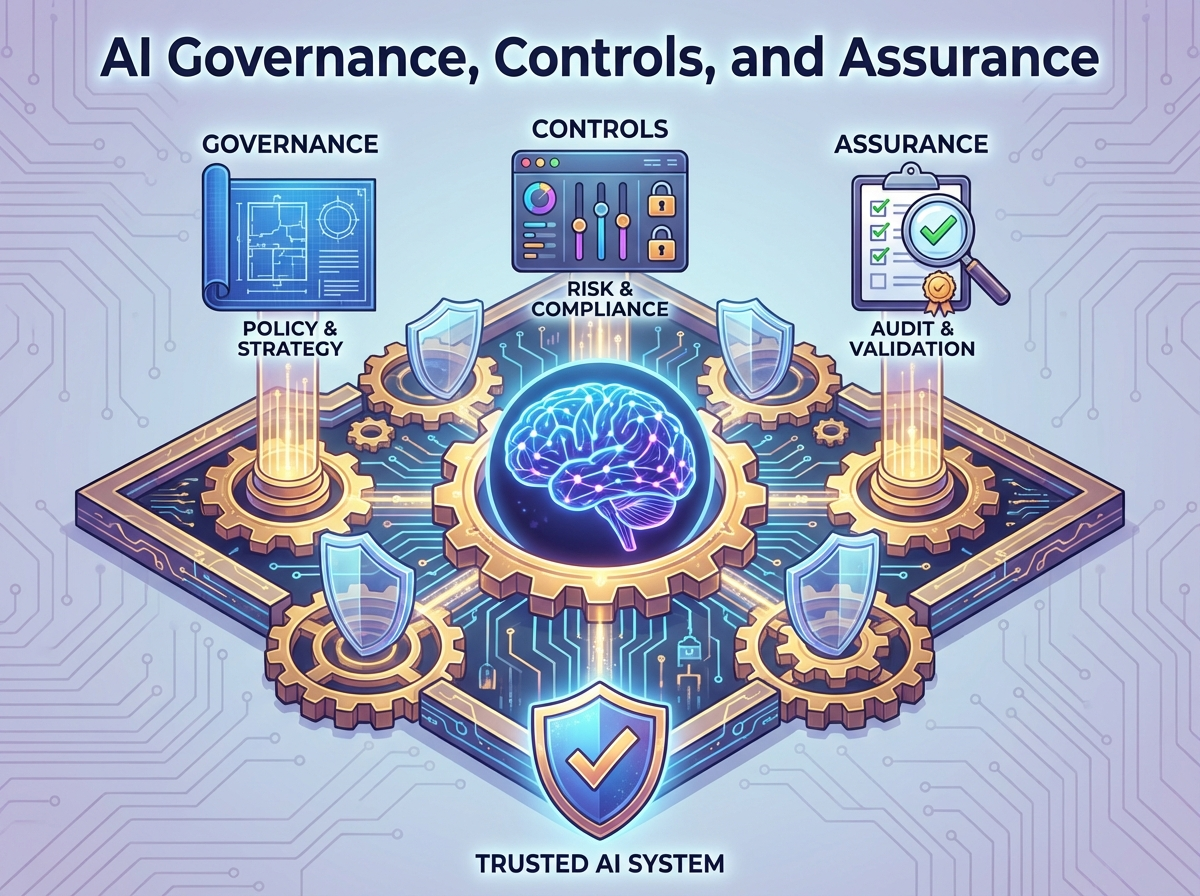
A helpful way to think about it is “documentation as a control surface.” You’re not writing prose; you’re creating handles the organisation can grab when something changes: a new vendor, a new data source, a new model version, a new market, or a new risk finding.

This lesson also connects directly to the evidence-bar approach and stage gates: the five proofs—value, feasibility, ownership, risk awareness, and measurement—should appear in your documentation progressively. Passing a gate without producing the corresponding artifacts is how teams end up with “prototype theatre” (great demos, weak proof) or “governance cliffs” (late discovery of non-compliance that forces a rebuild).

The minimum viable documentation set (by stage gate)

Lifecycle documentation works best when you define a minimum viable set per stage. That keeps momentum while ensuring each gate decision is backed by retrievable proof. The goal is not “more documents”; it’s the smallest set that eliminates preventable ambiguity.

Principle 1: Document choices, not just outputs

Many AI teams document what they built (a model, a prompt, a demo) but not why it’s shaped that way. The “why” is what governance, audit, and future maintainers need. Decisions like “human-in-the-loop required,” “no use of special-category data,” or “exclude billing disputes” are risk controls; if they aren’t recorded, they won’t survive scale.

Strong decision documentation has three properties. First, it is specific: it names the scope boundary and the reason (e.g., “Exclude Category X because it contains payment data; system is not approved for PCI scope”). Second, it is owned: it identifies who approved the tradeoff and who must be consulted if it changes. Third, it is testable: it implies what you will verify later (e.g., “logging includes redaction; verify via sample log review”).

A common pitfall is confusing documentation with “writing down everything.” That creates noise and slows delivery. The better practice is to document the irreversible and the safety-critical: data categories used and excluded, where the system sits in the workflow, what it is allowed to do automatically, what gets logged, and what guardrails must hold. Those are the agreements you don’t want to rediscover during an incident.

A typical misconception is that documentation is mostly for regulated industries. In reality, even non-regulated teams need it because AI systems degrade, vendors change, and humans adapt workflows. When the assistant’s output quality drops or a fairness concern appears, the organisation needs traceability to answer: “Which version? Which data? Which cohort? Which control failed?” Documentation is what lets you answer quickly—and fix confidently.

Principle 2: Match the artifact to the evidence bar (and keep it lightweight)

Stage gates work because each phase has a different learning goal. Documentation expectations should mirror that: lightweight but decisive early, and progressively more operational and auditable as you scale. If you demand production-grade runbooks in Discover, you get analysis paralysis. If you skip operational docs until Deploy, you get a governance cliff.

At Discover, the minimal artifacts are about decisionability: a one-page problem framing with a baseline and target outcome, named business and operational owners, a rough measurement approach, and preliminary risk categories (privacy, security, customer harm, bias). This is where you capture the “five proofs” at the level of plausible intent: enough to justify feasibility work.

At Feasibility, documentation shifts toward end-to-end reality. You need a data source and access register (what data, where from, refresh rate, sensitivity), an architecture/workflow placement sketch, and initial control decisions (logging, retention, human oversight, blocked topics, integration constraints). This is the stage where “we’ll integrate later” must be replaced with a concrete plan and constraints—written down.

At Validate, evidence becomes empirical. Your artifacts should include a pilot plan (cohort definitions, time window, attribution method), evaluation results tied to outcome metrics, and guardrail monitoring results (escalation rate, error types, policy violations, fairness checks where relevant). Crucially, you also document adoption/usage behavior—because a system that’s “accurate” but unused does not deliver value.

At Deploy, documentation becomes operational and governing: runbooks, monitoring dashboards and alert thresholds, incident response paths, auditability and access controls, and change management (who can change prompts/models, what testing is required, and what approvals are needed). The purpose is to prove not only that the system works, but that it can be owned safely over time.

The table below shows a practical “minimum viable” set aligned to the stage-gate intent.

Lifecycle moment What you must be able to answer Minimum viable artifacts (examples) Common failure if missing
Discover gate Is this a real problem with measurable value and owners? Use case one-pager (baseline, target KPI, guardrails), ownership map (business + ops), initial risk scan (risk categories + assumptions), measurement sketch Vague “strategic” pilots, no accountable adoption owner, late discovery of non-governable scope
Feasibility gate Can we run end-to-end within constraints (data, workflow, controls)? Data & access register (sources, sensitivity, refresh), workflow placement + integration plan, control decisions log (logging, retention, HITL), capacity alignment note (how many cases vs ops capacity) “We’ll integrate later,” security/legal surprises, throughput mismatch (10,000 flags vs 200 reviews)
Validate gate Does it move outcome metrics in real workflows with guardrails holding? Pilot plan (cohort, duration, method), evaluation report (impact vs baseline), guardrail report (errors, escalations, fairness/complaints), adoption telemetry summary (usage, overrides) Demo success mistaken for impact, biased pilot cohorts, guardrail regressions unnoticed
Deploy gate Can we operate, audit, and change it safely at scale? Runbook (SLOs, monitoring, incidents), audit/traceability pack (versioning, logs, access), change management policy (who/what/when), final sign-offs record Scaling without monitoring, unclear ownership when harm occurs, uncontrolled prompt/model changes

Principle 3: Design for traceability and change (because AI doesn’t stand still)

AI systems change more often than traditional software because models, prompts, retrieval sources, and policies evolve. Documentation therefore needs to support traceability across versions and safe change—not just “what is true today.” If your docs don’t track versions and approvals, you’ll be unable to explain why performance shifted or why a policy violation spiked.

Traceability starts with versioning what matters. For predictive ML, that includes feature definitions, training data snapshots, evaluation datasets, and model versions. For GenAI, it includes prompt templates, system instructions, retrieval sources (e.g., which knowledge base collections), guardrail configurations, and vendor/model endpoints. The goal is practical: when something goes wrong, you can reproduce conditions and diagnose whether the cause is data drift, a prompt change, a retrieval update, or user behavior changes.

A best practice that scales is maintaining a simple change record with three fields: what changed, why it changed, and what evidence was reviewed. Tie that record to the stage-gate “evidence bar” mindset: low-risk copy tweaks might require lightweight review, but changes that affect data scope, automation level, or customer-facing behavior should trigger stricter checks. Without this, “small edits” accumulate into ungovernable systems.

Pitfalls here are subtle. Teams often over-focus on the model and under-document the operational system: upstream data pipelines, downstream interventions, and human override paths. But many failures are systems failures—pipeline breaks, queue overload, ambiguous responsibility—not model failures. Documentation should therefore make the socio-technical system explicit: where humans intervene, what they see, what they are trained to do, and how exceptions are handled.

A common misconception is that traceability requires heavy tooling to start. Tooling helps, but you can achieve most of the benefit early with consistent templates and disciplined versioning. The requirement is not sophistication; it’s repeatability: every gate decision leaves a trail that a new team member, auditor, or incident commander can follow.

[[flowchart-placeholder]]

Two real-world documentation walk-throughs (what “good” looks like)

Example 1: GenAI customer support agent assist — avoiding the governance cliff

In Discover, the team documents a crisp outcome: “Reduce average handle time by 8% without decreasing CSAT or increasing escalations.” The one-pager includes baseline values, a 90-day measurement window assumption, and guardrails (CSAT and escalation rate). Ownership is documented explicitly: the support leader owns the KPI and adoption, while support ops owns rollout, coaching, and adherence. The initial risk scan states that ticket text may include sensitive data, so the solution must constrain data use and logging.

In Feasibility, the biggest documentation win is the data & control boundary. The team records that categories containing payment details are excluded and why, and that outputs are never auto-sent (human approval is mandatory). They document logging decisions: prompts and outputs are logged with redaction, and retention is constrained to an agreed window. They also capture the integration plan: the assistant lives as a side panel inside the existing ticketing tool, and the only grounding source is the approved knowledge base collection. This directly prevents a late-stage security/legal reversal where a popular prototype is deemed unusable.

In Validate, the pilot report distinguishes “looks good” from “moves the metric.” The team documents cohort selection (avoid only top performers), the experiment window, and how handle time improvements are attributed. They report not only outcome metrics but also adoption telemetry: accept/edit/reject rates and common override reasons. They also record an important limitation: junior agents benefit more than senior agents, and billing disputes show higher risk and lower utility. That documented insight becomes a scaling control—scope excludes certain ticket types until additional safeguards are added.

Impact, benefits, limitations: The organization can scale faster because governance questions are answered with artifacts, not meetings. The limitation is that documentation doesn’t substitute for good product design; if the workflow fit is poor, the pilot report will show low usage, and the right decision may be to pivot rather than scale.

Example 2: Credit risk early warning model — documentation as an audit trail, not a formality

In Discover, the team documents that this is a governed decision-support system, not “just analytics.” The outcome is defined (loss or delinquency reduction) with explicit guardrails: false positives must not trigger punitive actions, and fairness must be evaluated across relevant segments. Ownership is split and recorded: a finance leader owns business outcomes; an operations leader owns the intervention process (outreach playbooks, hardship options, review steps). The initial risk scan records legal and policy constraints around feature use and the need for explainability depending on usage.

In Feasibility, documentation focuses on what makes the system operable and defensible. The data register lists candidate features and explicitly notes which are excluded and why. Capacity alignment is written down: the outreach team can contact only 5% of accounts weekly, so the model must support prioritization and thresholding, not blanket flagging. Human-in-the-loop is documented as a control: model outputs lead to review and outreach offers, not automatic credit tightening. These artifacts prevent a common failure mode where a technically strong model becomes harmful because ops operationalizes it aggressively by default.

In Validate, the pilot report documents real-world outcomes and harm checks. It records how contacted vs non-contacted groups are compared and how results are interpreted (e.g., reducing loss vs merely shifting delinquency timing). Guardrails include complaint rates and remediation outcomes, and fairness checks are documented with observed performance differences and proposed mitigations. A key limitation is captured: model lift is strong but realized benefit is constrained by staffing and script quality. That documentation becomes a decision input—scale the operating model, narrow scope, or park the use case until intervention capacity matches ambition.

Impact, benefits, limitations: Documentation enables auditability and makes the “why” behind controls explicit—critical in high-stakes domains. The limitation is that strong documentation can’t compensate for misaligned incentives; if operations cannot or will not execute the intervention responsibly, the safest option may be to stop or redesign the use case.

Closing: documentation that keeps decisions fast and defensible

Lifecycle documentation expectations are how you turn stage gates from a meeting cadence into a governable delivery system. You document the minimum that preserves clarity: what value you’re targeting, how feasible end-to-end operation is, what risks you identified and controlled, and how you’ll measure and operate the system after launch.

The practical standard to hold: if a new stakeholder joins—security, legal, ops, or an executive sponsor—can they understand the use case well enough to approve (or challenge) it without reverse-engineering months of context?

Now that the foundation is in place, we'll move into KPIs, Ownership & Accountability [30 minutes].

Last modified: Friday, 6 March 2026, 6:05 PM