

User Journey Mapping for e-Commerce Platforms
User Journey Mapping for e-Commerce Platforms
Understanding the User Journey in e-Commerce
Imagine you're shopping online for a new pair of headphones. You browse through several options, read reviews, compare prices, and maybe even add a few to your cart before making a final decision. Each step you take from your initial search to the final purchase forms part of a user journey. This lesson will explore how mapping these journeys can enhance the user experience in e-commerce platforms.
Understanding the customer journey is crucial for e-commerce retailers looking to optimize their platforms to increase sales, customer satisfaction, and brand loyalty. Let's dive into how user journey mapping can become an indispensable tool in your UX design toolbox.
The Essentials of User Journey Mapping
User Journey Mapping is a visualization of the process that a user goes through to achieve a goal on your platform. It includes all the interactions at every touchpoint and helps uncover user intentions, motivations, and potential frustrations. A journey map can be an essential component for creating an effective and empathetic user experience in e-commerce.
Key terms to know:
-
Touchpoints: All the interactions customers have with a brand throughout their journey.
-
Pain Points: Areas where users experience difficulties or frustrations.
-
Persona: A semi-fictional character created based on your ideal customer, incorporating demographics, behaviors, and motivations.
In earlier lessons, you learned about understanding user needs and defining personas. Journey mapping builds on these skills by providing a structured way to visualize and improve the overall e-commerce experience.
Methods and Dimensions of User Journey Mapping
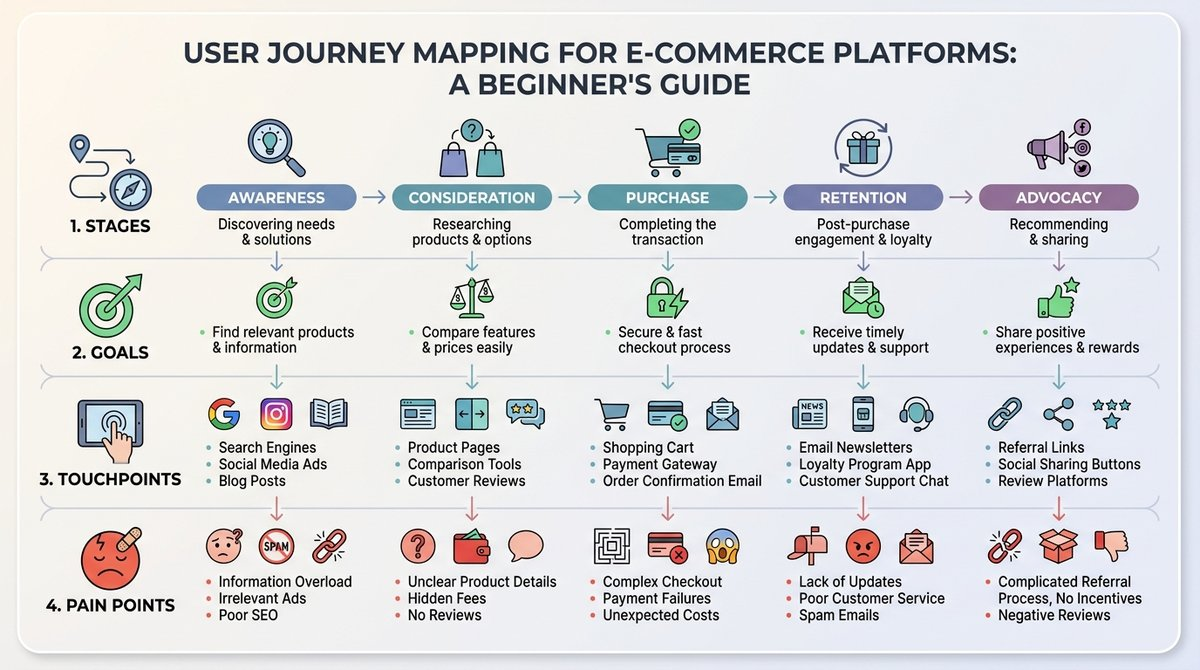
Journey mapping can be broken down into several core components, each playing a crucial role in creating a comprehensive view of the user experience.
-
Stages in the Journey: Identify the primary stages a user goes through, such as Awareness, Consideration, Purchase, and Loyalty.
-
User Goals: At each stage, users have specific goals they want to achieve, such as finding product information or completing a purchase.
-
Touchpoints and Channels: These are specific interactions such as visiting a website, interacting through email, or contacting customer service.
Here's a breakdown in table form:
| Component | Description | Example |
|---|---|---|
| Stages | High-level steps in the user interaction process. | Awareness, Consideration, Purchase, Loyalty |
| Goals | What users aim to accomplish at each stage. | Find product details, compare prices, check out efficiently |
| Touchpoints | Points of interaction users have with the platform. | Website, Email, Customer Service |
| Pain Points | Frustrations or issues encountered along the journey. | Slow page load times, complicated checkout process |
Effective mapping requires attention to detail and a focus on how each journey stage interlinks with the rest of the process.
Best Practices and Pitfalls
Best Practices
- Involve Cross-Functional Teams: Collaborative input from marketing, sales, and customer support teams ensures diverse perspectives.
- Use Real Data: Validate assumptions with data from analytics tools, such as Google Analytics, to pinpoint where users drop off.
- Focus On User Emotions: Understanding the emotional state of users can uncover deeper truths about user behavior and needs.
- Iterative Approach: Regularly update and refine maps as user behaviors and market conditions change.
Common Pitfalls
-
Ignoring Key Touchpoints: Overlooking certain stages, especially post-purchase, can miss opportunities to engage customers further.
-
Assuming Linear Journeys: Users may jump between stages non-linearly; therefore, flexibility in mapping is vital.
-
Overcomplicating Maps: Keep maps clear and straightforward to ensure they are actionable, not just theoretical exercises.
Real-World Applications in e-Commerce
Example 1: Online Retail Store
Consider an online clothing retailer aiming to improve its checkout process. By mapping the journey from product discovery to purchase, designers identify that cart abandonment often occurs due to unclear shipping information. Adjustments, such as displaying shipping costs upfront and simplifying the checkout form, lead to a significant increase in completed purchases.
Example 2: Subscription Box Service
A subscription box service discovers through journey mapping that potential customers abandon sign-up at the customization stage. The service tweaks its journey, offering a simplified and visually engaging way to select preferences, resulting in higher conversion rates.
These examples illustrate the practical impact of understanding and refining user journeys, showcasing how avoiding unnecessary complexities and focusing on user convenience can directly affect business outcomes.
Bringing It All Together
User journey mapping is about understanding and improving the experience of your e-commerce platform from the user's perspective. By visualizing and analyzing each step of the customer journey, UX designers can create more intuitive, satisfying experiences that boost business performance.
The Power of Empathy in Design
-
Comprehensive Understanding: Aligns with real-world behaviors and needs.
-
Increased Conversion Rates: By addressing pain points and streamlining processes.
-
Enhanced User Satisfaction: Through personalized and valuable interactions.
Each step on the journey map represents an opportunity for your business to engage with users more effectively. As you continue to implement these methods, you’ll be able to craft superior e-commerce experiences that resonate with your audience.
You've now built a robust foundation in user journey mapping, tying together insights about user needs and behaviors to achieve the ultimate goal: a seamless and engaging e-commerce experience.