

Creating and Utilizing User Personas
Creating and Utilizing User Personas
Understanding User Personas in e-Commerce UX Design
Journey into e-Commerce User Experience
Imagine browsing an online store optimized specifically for you. Each product suggestion, page design, and checkout process seems tailored just for your preferences. This isn't coincidental magic but the power of well-crafted user personas driving a seamless user experience (UX).
In the competitive world of e-Commerce, understanding your audience is paramount. Creating user personas helps businesses cater to their consumers effectively, streamlining their digital journey and increasing sales. In this lesson, we'll explore how constructing user personas is crucial in designing UX that resonates with real users. Let’s dive into the process, understand its significance, and see real-world applications.
What are User Personas?
User Personas are fictional characters created to represent the various user types that might engage with a product or service. These personas embody the characteristics, needs, goals, and behaviors of a larger user group, serving as a guiding star for UX design decisions.
-
Definitions and Principles:
Who they are: Personas are not just based on speculative demographics but are derived from actual research and data.
Why they matter: By creating a vivid picture of your ideal users, personas help keep the design process user-focused, improving user satisfaction and business outcomes. -
Key Components:
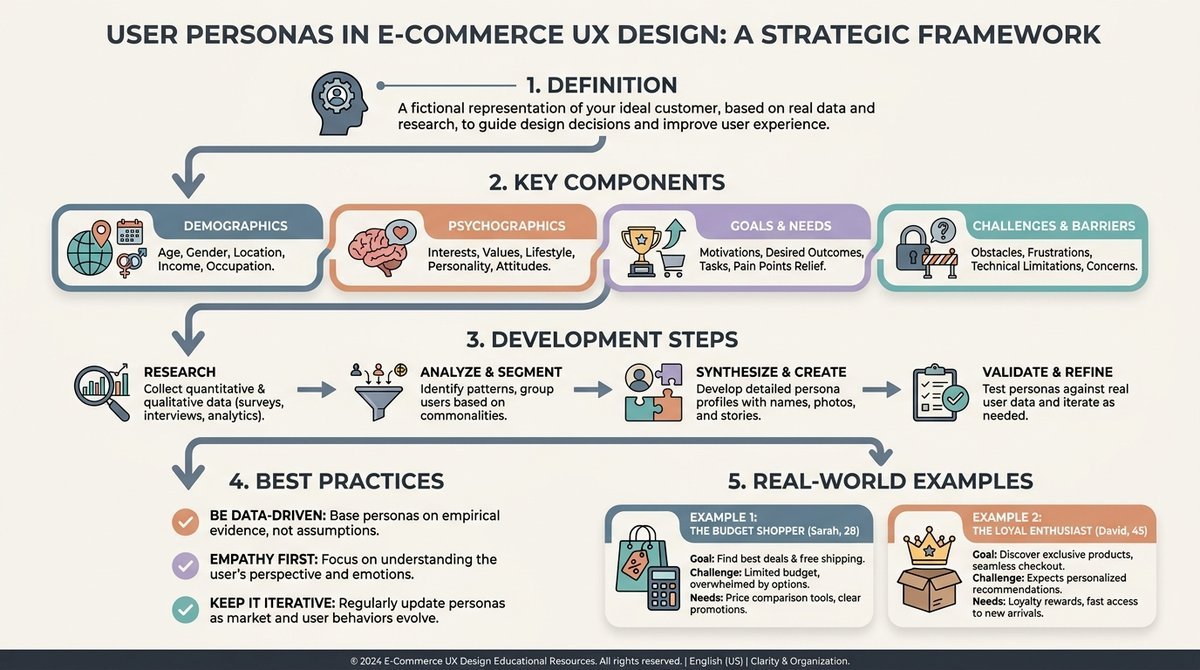
- Demographics: Age, gender, occupation, education level, etc.
- Psychographics: Interests, attitudes, values, and lifestyle choices.
- Goals and Needs: What the user aims to achieve using the product.
-
Challenges: Pain points or obstacles the user might face in their journey.
-
Previous Lessons Tie-In: In previous discussions, we've touched on understanding user needs. Here, personas serve as a bridge to apply that insight concretely in the design.
Developing Detailed User Personas
Crafting detailed user personas involves a series of steps that refine raw data into usable insights:
- Research and Data Gathering:
Conduct surveys, interviews, and analyze customer interactions.
Gather quantitative data (like age and location) and qualitative data (such as personal goals). - Identifying Patterns:
Look for common characteristics, goals, and pain points among your users.
Segregate users into distinct groups with similar traits. - Creating Persona Profiles:
Assign names and photographs to humanize the persona.
Develop detailed backstories and include fictional, yet realistic attributes. - Iterate and Validate:
Regularly update personas based on new research findings.
Ensure that personas evolve as business goals and market landscapes change.
Best Practices & Pitfalls:
| Aspect | Best Practices | Common Pitfalls |
|---|---|---|
| Research | Use diverse data sources for insights | Over-relying on assumptions |
| Profiles | Maintain realism with detailed, relatable characters | Creating generic personas lacking depth |
| Validation | Involve cross-functional teams to critique and test personas | Ignoring feedback and sticking to initial versions indefinitely |
| Iteration | Regularly refresh and adapt personas to current market conditions | Treating personas as a one-time project |
Real-World e-Commerce Persona Examples
Let’s explore how user personas manifest in e-Commerce settings with two examples:
Example 1: The Tech-Savvy Millennial
-
Persona Profile:
Name: Alex Johnson
Age: 29
Occupation: Software Engineer
Goals: Seeks cutting-edge tech gadgets that integrate into their smart home ecosystem.
Challenges: Information overload, wants quick and concise product comparisons. -
Application:
Personalization: Websites can prominently feature tech comparison tools and smart home integration guides.
Enhanced Experience: Simplified UI with quick filters and snapshot reviews for busy lifestyles.
Example 2: The Bargain-Hunting Parent
-
Persona Profile:
Name: Sarah Ortiz
Age: 35
Occupation: Stay-at-home parent
Goals: Looking for quality children's wear at affordable prices.
Challenges: Limited time for shopping, prefers seamless mobile browsing. -
Application:
Custom Solutions: Send personalized deals and bundles aligning with buying patterns.
Mobile Optimization: Ensure a smooth, intuitive mobile interface enabling fast and efficient shopping.
These personas help designers visualize user journeys beyond demographics, diving into real needs and motivational contexts. This maximizes user engagement and satisfaction, ultimately driving conversions.
Bringing it All Together
User personas are the linchpin of effective UX design. By creating and utilizing these profiles, businesses gain the ability to tailor experiences that deeply resonate with users, fostering loyalty and maximizing competitive advantage.
Up next: Conducting e-Commerce User Research — where this becomes even more practical.