

Conducting e-Commerce User Research
Conducting e-Commerce User Research
Understanding e-Commerce User Research
Imagine you're launching a new online retail platform. You have compelling products and a robust inventory, but sales expectations aren’t being met. One crucial aspect might have been overlooked: the users' experience. Conducting effective user research not only informs design choices but also plays a significant role in enhancing user satisfaction and optimizing the buyer journey on e-commerce platforms. Let's delve into the critical process of understanding and conducting user research specifically tailored for e-commerce contexts.
Exploring the Essentials of User Research
In the context of e-commerce, user research is the practice of understanding user behaviors, needs, and motivations through observation techniques, task analysis, and other feedback methodologies. Unlike traditional business settings, e-commerce user research is dynamic and fast-paced due to constantly evolving user expectations and technological advancements.
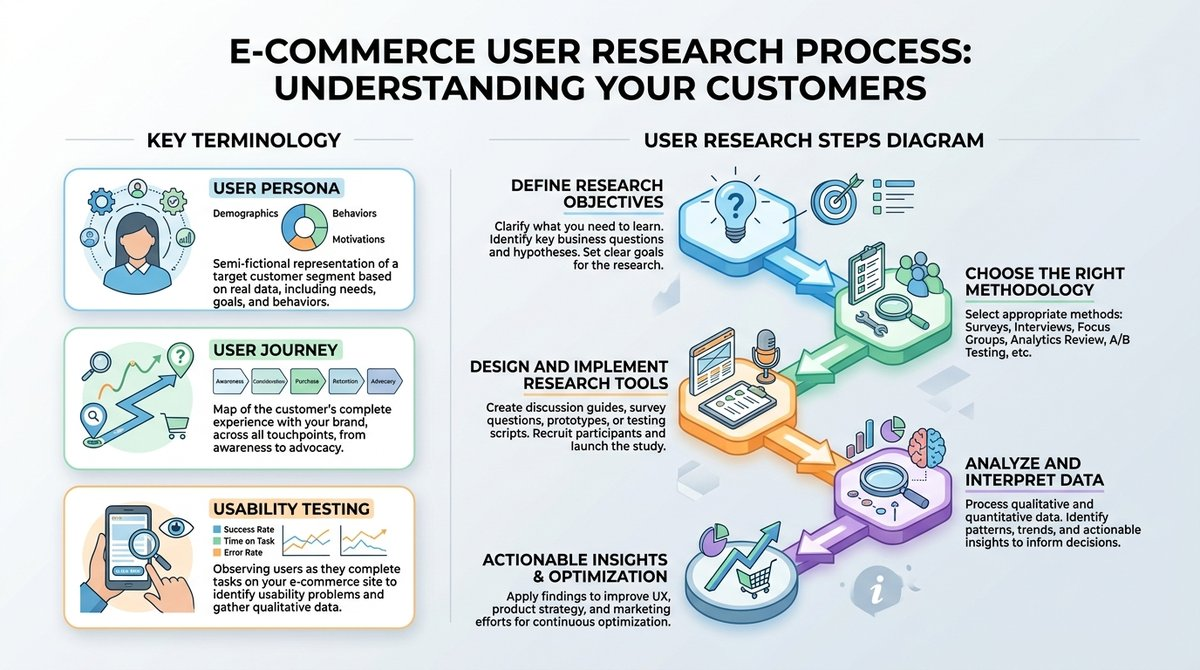
- Key Terminology:
User Persona: A semi-fictional representation of your ideal customer based on market research and real data about your existing customers.
User Journey: The path a user takes to complete an activity or achieve a goal on your website.
Usability Testing: Observing real users interact with the product to discover usability issues.
Imagine user research as detective work. You're gathering clues to solve the mystery of enhancing customer satisfaction while boosting sales. Knowing the intricacies of your users' interactions can highlight what works and reveal what doesn’t in the current design or process.
Delving Deeper into User Research Processes
Successfully conducting user research involves a series of steps which we will explore in more detail:
-
Define Research Objectives: Clearly specify what you need to learn. It might be understanding customer's behavior patterns, preferences in product layout, or navigational inefficiencies.
-
Choose the Right Methodology: Depending on your objectives, decide whether you need qualitative methods (like interviews) for deeper insight into motivations or quantitative methods (like surveys) for statistical validation.
-
Design and Implement Research Tools: Formulate surveys or interview questions designed to elicit honest and insightful responses.
-
Analyze and Interpret Data: Review the data collected to identify patterns and make data-driven decisions.
Table: Comparison of User Research Methods
| Method | Purpose | Strengths | Limitations |
|---|---|---|---|
| Interviews | Gain deep insights into user motivations | In-depth understanding, rich data | Time-consuming, potential bias |
| Surveys | Gather data from a large audience | Scalable, cost-effective | No detailed insights, reliant on truthful responses |
| Usability Tests | Observe real-time user interaction | Identifies usability issues quickly | Requires facilitation, potential for observer effect |
| Analytics | Track and analyze usage patterns | Real-time data, behavior tracking | May lack context, quantitative focus only |
Best practices in user research highlight the need to remain objective and open-minded, while common pitfalls often include drawing conclusions from insufficient data and assuming prior knowledge over verified insights. Misconceptions such as "We already know our users" can lead to gaps in understanding the nuanced needs and desires of buyers.
Real-World Applications in e-Commerce
Example 1: Increase Conversion Rates
Suppose an online apparel store identifies that potential customers routinely abandon their shopping carts. By conducting user interviews, the business discovers that shipping fees are unexpectedly added in the final step of the checkout process, deterring purchases. This insight leads to a transparent pricing strategy earlier in the user journey, resulting in improved conversion rates.
Example 2: Navigating Redesigns
Consider a company looking to redesign its online interface. Before doing so, it deploys analytics and usability tests to track the most utilized features. Discovering that users often struggle with the search function, the company optimizes this feature, significantly enhancing user satisfaction and decreasing bounce rates.
In these examples, you see how meticulously gathered user data directly informs productive changes, emphasizing the relevance of user research within broader business strategies.
Pulling It All Together
User research is a powerful ally in the e-commerce domain. It bridges the gap between user expectations and business objectives. By adhering to the research methodologies addressed in this lesson, you ensure that your design decisions are not only user-centric but also commercially viable.
Now that the foundation is in place, we'll move into User Journey Mapping for e-Commerce Platforms where this becomes even more practical, allowing you to visualize and enhance the complete customer experience on your platform.