

Importance of UX in e-Commerce
Importance of UX in e-Commerce
Enhancing e-Commerce Through UX Design
In the rapidly evolving world of online shopping, user experience (UX) has become a crucial element of successful e-Commerce platforms. With consumers in constant search of convenience and satisfaction, how a user interacts with an online store directly influences their purchasing decisions. Imagine browsing an online store where pages load slowly, navigation is confusing, and the checkout process is tedious. Would you return? This lesson delves into why UX is pivotal in the e-Commerce world and how mastering its fundamentals can elevate an online business's success.
Defining UX: The User's Journey
User Experience (UX) refers to the overall experience a person has when interacting with a product or service. It involves usability, design, accessibility, and user satisfaction. In e-Commerce, UX design ensures that consumers can seamlessly browse, search for products, make purchases, and receive customer support. The goal is to create a positive journey from the moment a visitor enters your website to the final transaction.
In the previous lesson, we discussed the basics of UX design. Now, we focus on its significance in e-Commerce, highlighting how UX elements can optimize user satisfaction and business results. Just as a knowledgeable salesperson can guide a customer through a physical store's aisles to ensure they find what they seek, a well-designed UX leads users to their desired products with ease.
Core Principles of UX in e-Commerce
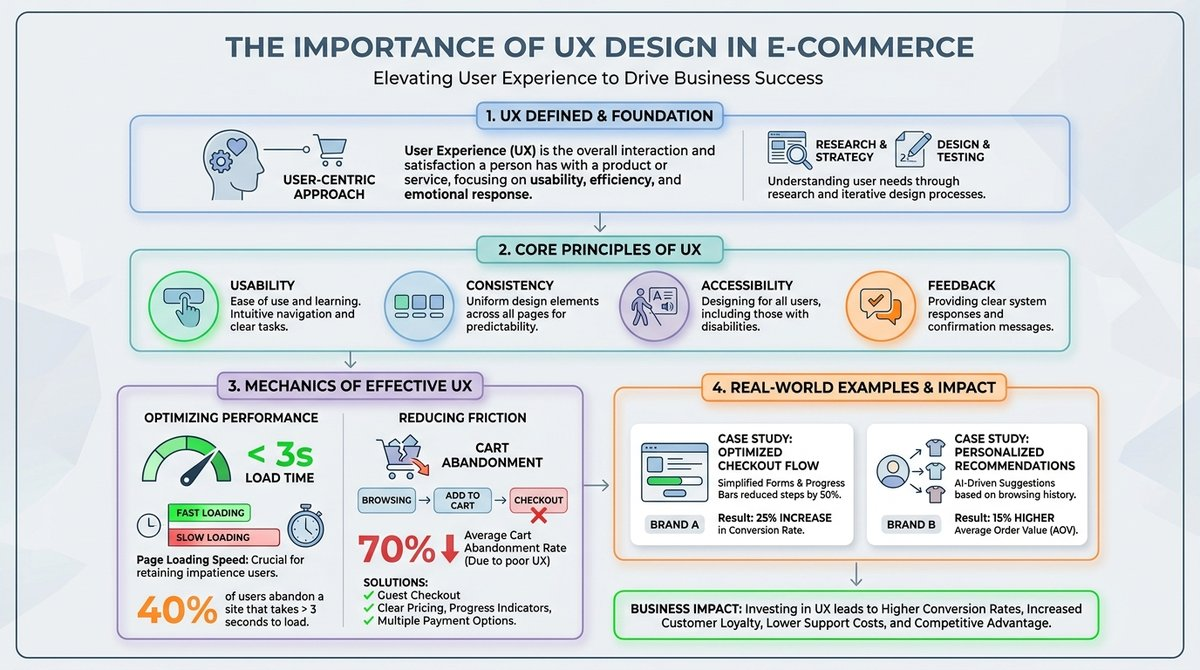
In e-Commerce, UX design isn't just about aesthetics; it's about creating an efficient, enjoyable shopping experience. Here are some foundational principles:
-
Usability: Ensures systems are easy to learn and use. Good usability allows users to complete their tasks efficiently without errors.
-
Consistency: Refers to uniform design and navigation systems across the website. This helps users familiarize themselves quickly.
-
Accessibility: Design must be inclusive, catering to users with various disabilities, ensuring everyone can interact with the site effectively.
-
Feedback: Provides users with real-time feedback about their actions on the site. For example, confirmation messages after a product is added to the cart reassure users the action was successful.
The Mechanics of Effective UX in e-Commerce
To grasp how UX influences e-Commerce success, let us explore several elements in depth:
-
Responsive Design: Ensures the website adapts to various devices, be it mobile phones, tablets, or desktops. Given an increasing number of users access sites via mobile devices, a responsive design ensures every user has an optimal browsing experience, regardless of their device.
-
Page Loading Speed: A key factor determining whether a user stays or leaves a website. According to research, 40% of users abandon a website that takes more than three seconds to load. Fast-loading pages improve user satisfaction and keep them engaged.
-
Intuitive Navigation: Users should easily find what they're looking for without getting lost. This involves a clean, logical menu structure and a robust search feature. Breadcrumbs and clear call-to-action buttons help guide users efficiently through the site.
-
Checkout Process: Streamlining the checkout process is critical. A simplified, secure checkout reduces cart abandonment rates. Offering multiple payment options and allowing guest checkout can further enhance the user experience.
These components, when combined effectively, cultivate trust and retain users, thus boosting conversion rates and fostering customer loyalty.
Illustrated Impacts: Real-World Examples
Example 1: A Clothing Retailer Optimizes Mobile UX
Consider a clothing retailer that revamps its website to focus on mobile users, given that 70% of its traffic derives from mobile devices. By implementing a responsive design, fast loading times, and easy navigation optimized for touch interface, the retailer sees a 30% increase in mobile sales within three months. The conversion rate improves as users experience a more pleasant browsing experience, encouraging them to make purchases.
Example 2: A Home Goods Store Enhances Checkout
A home goods e-Commerce site reduces its cart abandonment rate by streamlining its checkout process. Initially requiring users to fill out extensive forms and create an account, which frustrated customers and led to exits, the company redesigned the process. They now include a guest checkout option and use auto-fill technology to expedite form completion. As a result, they witness a 25% decrease in cart abandonment and a significant boost in completed sales.
Bringing It All Together
UX design in e-Commerce is not just a supplementary aspect of your business strategy; it is foundational. A well-crafted UX can set a business apart in a crowded market, fostering trust and encouraging repeat customers. The convergence of user-centric design with business objectives creates a potent formula for success.
This sets you up perfectly for Key Elements of UX Design where we'll dissect the components that contribute to an exceptional user experience in more detail. By understanding, implementing, and continuously refining UX strategies, e-Commerce entities can thrive in understanding, engaging, and satisfying their users.