

Applying Data Concepts
Applying Data Concepts
4.1: Applying Data Concepts
Imagine walking into a HEMA store and noticing how seamlessly their online and in-store systems identify your preferences to personalize your shopping experience. This kind of efficiency doesn't happen by chance; it's the result of a well-structured data governance and modeling system working behind the scenes. In today’s lesson, we’ll uncover how data governance, quality, and modeling play a vital role in such operations, ensuring that the data remains consistent, accurate, and secure across all levels of the organization.
To understand why these concepts matter, let's first define the core terms. Data governance is essentially a framework that ensures data is managed consistently and utilized effectively. It's the backbone of any data-driven strategy, laying out policies and responsibilities to maintain data integrity. Data quality, a key element of governance, refers to how well the data serves its intended purpose, emphasizing accuracy, completeness, and reliability. Meanwhile, data modeling provides a visual representation of data flow and relationships, crucial for structuring databases that support operations at HEMA.
Building on what we explored in previous lessons—where we laid the groundwork for understanding these concepts—today, we’ll deepen our comprehension by exploring their interrelationships. Let's use the analogy of a library system: just as librarians ensure that books are correctly cataloged and maintained (data governance), the books themselves need to be free of errors and readily available (data quality). The library map that shows the location and categories of books is akin to data modeling—it organizes and provides a clear overview of the library’s collection.
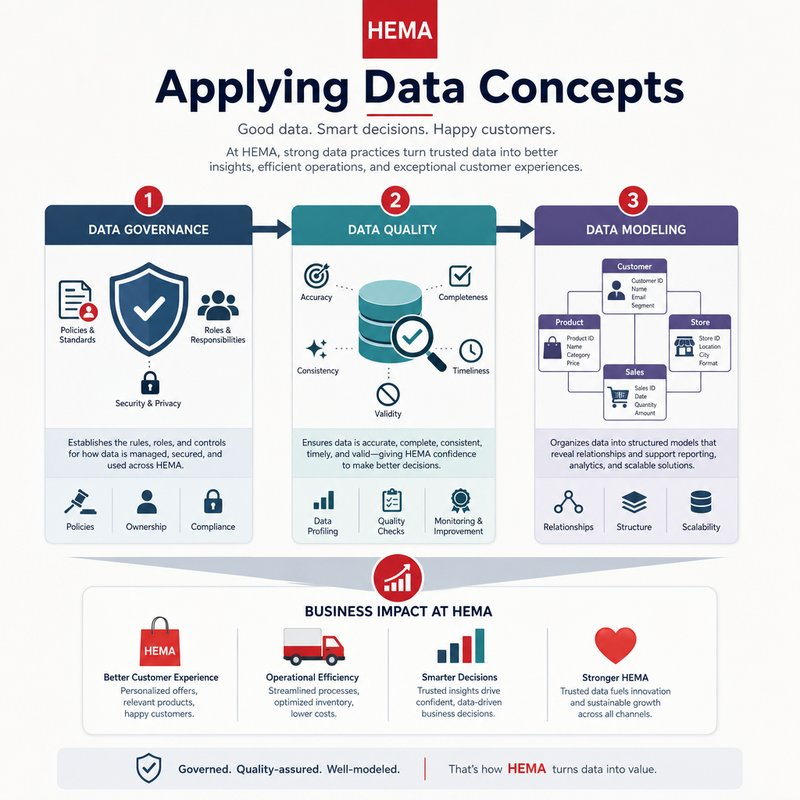
Diving deeper, consider data governance's role at HEMA. It aligns with best practices like defining data ownership—ensuring that employees understand their roles concerning data handling—and establishing guidelines for data usage and privacy. A common pitfall to avoid is neglecting these governance policies, which could lead to data breaches or compliance issues.
When looking at data quality, think of key metrics such as timeliness and accuracy. For instance, if inventory data isn't updated promptly, customers might find out too late that a product is out of stock. Techniques like data cleansing and validation are essential to mitigate such risks. In data modeling, employ Entity-Relationship Diagrams (ERDs) to visualize data relationships, promoting a better understanding and design of HEMA’s databases to support applications across the business.
To bring these concepts to life, let’s look at practical applications within HEMA. One example involves integrating customer purchase histories into a centralized database to enhance marketing strategies. Using SQL, they might extract and transform data:sql
-- Example SQL query to retrieve customer purchase history
SELECT customer_id, product_id, purchase_date
FROM sales
WHERE purchase_date BETWEEN '2022-01-01' AND '2022-12-31'
ORDER BY customer_id, purchase_date;
Each part of this query serves a purpose: it selects relevant fields, filters the data set to the desired timeframe, and organizes it for analysis.
In another scenario, consider inventory management. Data governance ensures that inventory data follows set protocols for updates and audits, reducing errors and maintaining stock levels efficiently. Using data models can streamline operations, making predictions about stock requirements more accurate.
As we wrap up, it's clear that a thorough understanding of data governance, quality, and modeling is not just academic—it's a practical necessity for optimizing operations and enhancing customer satisfaction. In our next lesson, we'll build on these concepts and explore customer data management, diving into how data-driven insights directly improve customer interactions.
We'll apply tools and frameworks to ensure these data concepts are seamlessly integrated into everyday business workflows. Through these applications, we continue to bolster HEMA's capability to adapt in a rapidly evolving retail landscape.