

Introduction to Data Modeling
Introduction to Data Modeling
3.1: Introduction to Data Modeling
Imagine walking into a bustling HEMA store, where every item from clothing to home goods is perfectly organized. Have you ever wondered how a department store manages its immense inventory accurately? This intricate system relies heavily on effective data governance, data quality, and data modeling. In today's lesson, we'll introduce data modeling—an essential component in structuring data so it serves decision-making processes efficiently.
To appreciate why data modeling is crucial, let's connect it to what you've learned about data quality. Previously, we discussed how maintaining high-quality data is like ensuring fresh produce in a grocery store: only good inputs lead to satisfactory outputs. Building on that, data modeling is akin to creating the schematic of our store, designing how data should be organized, categorized, and related.
At its core, data modeling involves defining how data is interconnected, which lays the groundwork for smooth data flow and accessibility. Imagine it as the blueprint of a building that helps determine where each room should be placed for optimal functionality. By using established models, such as conceptual, logical, and physical data models, you can ensure that data within HEMA is organized logically, making data retrieval both efficient and intuitive.
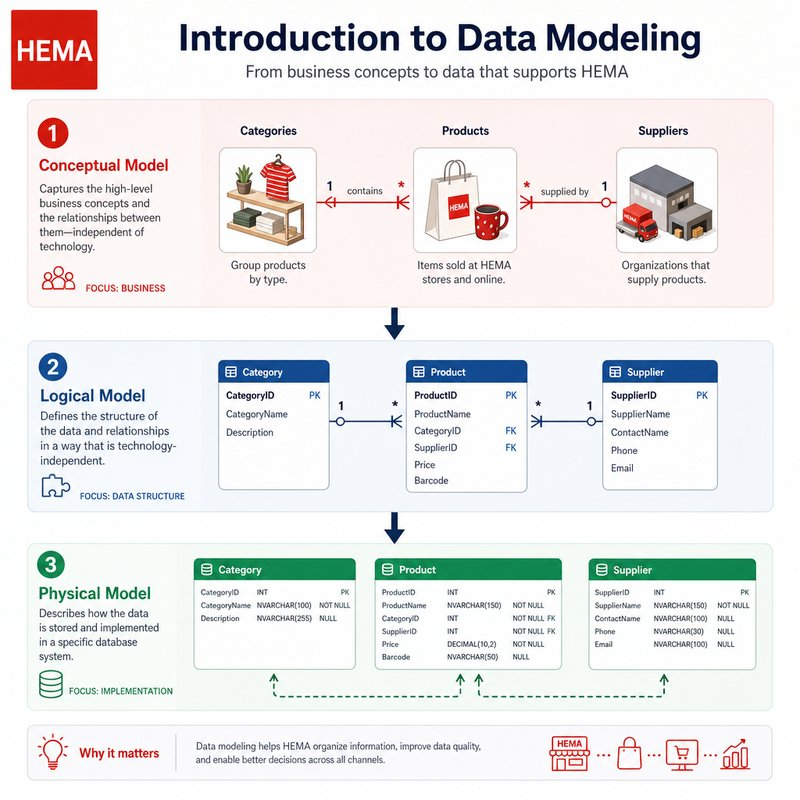
To explore this further, consider conceptual data models as high-level outlines that define business entities and relationships without worrying about technical specifics. Logical models delve deeper, specifying attributes and data types, much like deciding the furniture for each room in our building. Finally, physical data models translate these designs into actual databases, representing the exact layout of our inventory systems.
Data modeling also involves understanding best practices to prevent common pitfalls. For instance, neglecting to update a model when business requirements change can lead to inefficiencies and errors. As you dive deeper, remember that data models evolve, reflecting the dynamic nature of business operations.
Let's look at a practical application. Suppose HEMA wants to revamp its inventory system. A conceptual model would define entities like products, categories, and suppliers. The logical model would describe attributes for each entity, such as product ID, name, and price. Ultimately, the physical model could be implemented in SQL with tables and relationships ensuring data integrity and speed.sql
CREATE TABLE Products (
ProductID INT PRIMARY KEY,
Name VARCHAR(255),
Price DECIMAL(10,2),
CategoryID INT,
FOREIGN KEY (CategoryID) REFERENCES Categories(CategoryID)
);
Another real-world example: HEMA's customer data. A clear data model ensures customer interactions, purchases, and preferences are stored coherently, facilitating personalized marketing and improved customer service.
Bringing these models to life requires careful consideration and iteration. As you experiment with these concepts, always keep scalability in mind; data models must be adaptable to HEMA’s growing needs.
In summary, data modeling is the foundation upon which effective data management systems are built. It enhances data quality and governance by structuring data logically, ensuring seamless operations. As we move to the next lesson, "Types of Data Models," you'll gain insights into specific models used in various contexts. This will build on our current understanding and further equip you to craft robust data strategies.
Earlier lessons taught us about ensuring data quality, which directly complements today's exploration of data modeling. Anticipate how these models underpin the organization of HEMA's vast data landscape, forming the backbone of efficient data management.