

Key Kaizen Principles
Key Kaizen Principles
Unleashing Continuous Improvement in Finance: Key Kaizen Principles [20 minutes]
Financial institutions are constantly pressured to innovate and remain competitive. In this fast-paced environment, having a strategy for continuous improvement can be the difference between leading the market and just keeping up. Kaizen, a Japanese philosophy that translates to "change for better," emphasizes the importance of small, incremental improvements. While traditionally associated with manufacturing, the finance sector can greatly benefit from embracing Kaizen principles to drive efficiency, reduce waste, and enhance service quality. Let's explore how this can transform financial operations to meet the modern challenges.
Understanding Kaizen: Core Concepts
What is Kaizen?
At its heart, Kaizen is about continuous improvement. It involves every member of an organization, encouraging small, daily changes that collectively lead to significant improvements over time. Kaizen is centered around the involvement of all employees: from top executives to front-line workers, promoting a culture where everyone is accountable for identifying areas for enhancement.
Key Principles
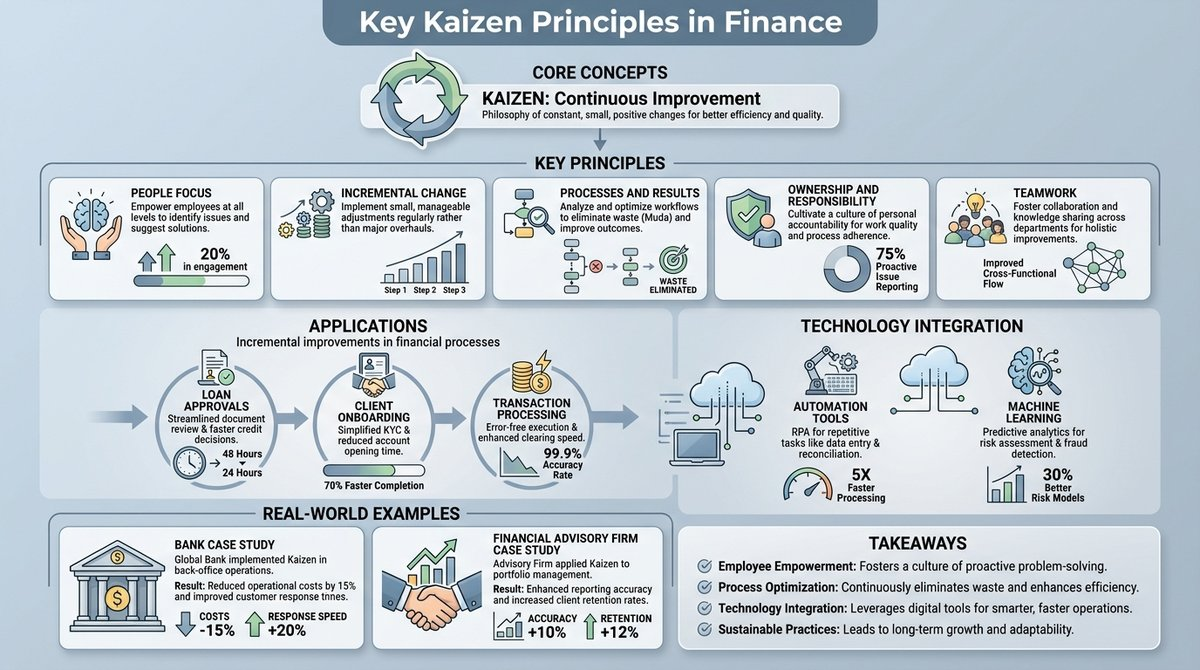
Kaizen is grounded in several core principles:
-
People Focus: Engaging employees at all levels to contribute ideas for improvement.
-
Incremental Change: Prioritizing small, manageable changes over time, rather than large upheavals.
-
Processes and Results: Focusing on improving existing processes for better outcomes.
-
Ownership and Responsibility: Encouraging team members to take ownership of their work and its improvement.
-
Teamwork: Fostering collaboration to solve problems and innovate.
By adhering to these principles, financial services can streamline operations, improve customer satisfaction, and eliminate inefficiencies.
Delving Deeper: Finance Applications and Benefits
Incremental Improvements in Financial Processes
In finance, Kaizen can manifest through streamlining processes such as loan approval, client onboarding, and transaction processing. For example, a bank might form cross-functional teams to review and improve the steps involved in processing a loan application. These teams can identify bottlenecks or redundancies and suggest minor adjustments that, when implemented, significantly reduce processing time and improve customer experience.
Benefits include:
-
Reduced operational costs due to increased efficiency.
-
Enhanced service delivery speed, leading to increased customer satisfaction.
-
Improved compliance and reduced risk from standardized and optimized processes.
Technology Integration and Kaizen
Innovation is key in the finance sector, and integrating technology through Kaizen can keep institutions ahead. Automation tools can be identified and implemented incrementally, reducing manual errors and freeing up staff for more strategic tasks.
Consider a scenario where a financial institution adopts machine learning algorithms for risk assessment. Initially, the team may start by automating data collection stages, gradually extending to more complex analyses as confidence in the new system grows.
Building a Culture of Collaboration
A major component of Kaizen is enhancing teamwork and collaboration. Financial teams often consist of diverse professionals, including accountants, analysts, and customer service reps. By applying Kaizen, teams are encouraged to work together, share insights, and devise improvements that benefit the entire organization.
Real-World Examples: Kaizen in Action
Streamlining Loan Approvals
A leading bank identified that its loan approval process was cumbersome, taking up to a week to approve simple consumer loans. Implementing Kaizen, the bank dedicated a small team to map the process, identify redundancies, and introduce digital signature technology. The result? Approval times reduced from seven days to one day, significantly enhancing customer satisfaction and improving the bank’s competitiveness.
Impact:
-
Reduction in potential lost business due to the delayed process.
-
Increased customer loyalty and positive word-of-mouth.
Optimizing Customer Service
In another instance, a financial advisory firm used Kaizen to improve its customer service. By collecting daily feedback and encouraging suggestions from frontline employees, the firm identified that clients were frequently confused about investment reports. By redesigning these reports to make them more user-friendly, the firm not only improved client satisfaction but also reduced the volume of service calls seeking clarification.
Impact:
-
Enhanced client understanding and confidence in services.
-
Improved staff efficiency by reallocating time from answering calls to providing strategic advice.
A Holistic Approach: Integration and Sustainability
The success of Kaizen in finance lies in its holistic approach. It's crucial to integrate these principles into the core strategies of the organization for sustainable growth. Management support, ongoing training, and transparent communication are essential components for embedding a continuous improvement culture. By involving all layers of the organization, Kaizen not only drives operational excellence but also fosters a more committed and motivated workforce.
Takeaways and Future Pathways for Kaizen in Finance
-
Employee Empowerment: Engaging employees to harness creativity and innovation.
-
Process Optimization: Focusing on continuous, incremental improvements to eliminate inefficiencies.
-
Technology Integration: Seamlessly combining new technologies with existing processes for added value.
-
Sustainable Practices: Developing a culture that consistently promotes improvement for long-term success.
Next, we'll build on this by exploring Kaizen Application in Finance, where these principles become even more practical within day-to-day operations.