

Engaging Teams for Continuous Improvement
Engaging Teams for Continuous Improvement
Engaging Teams for Continuous Improvement [20 minutes]
Why Team Engagement is Critical in Finance
Imagine working in a finance department where processes are static, and individual effort isn't maximized. Imagine stakeholders lamenting over common mistakes as financial operations lag because there's no platform for improvement. In the dynamic finance sector, continuous improvement isn't a luxury—it's essential. Here, engaging teams is the cornerstone of such adaptability.
In today's lesson, we'll focus on how the Kaizen philosophy of continuous improvement can be effectively applied in finance by actively involving every team member. This approach not only enhances efficiency but also fosters a more motivated and cohesive work environment.
Understanding Key Principles of Kaizen
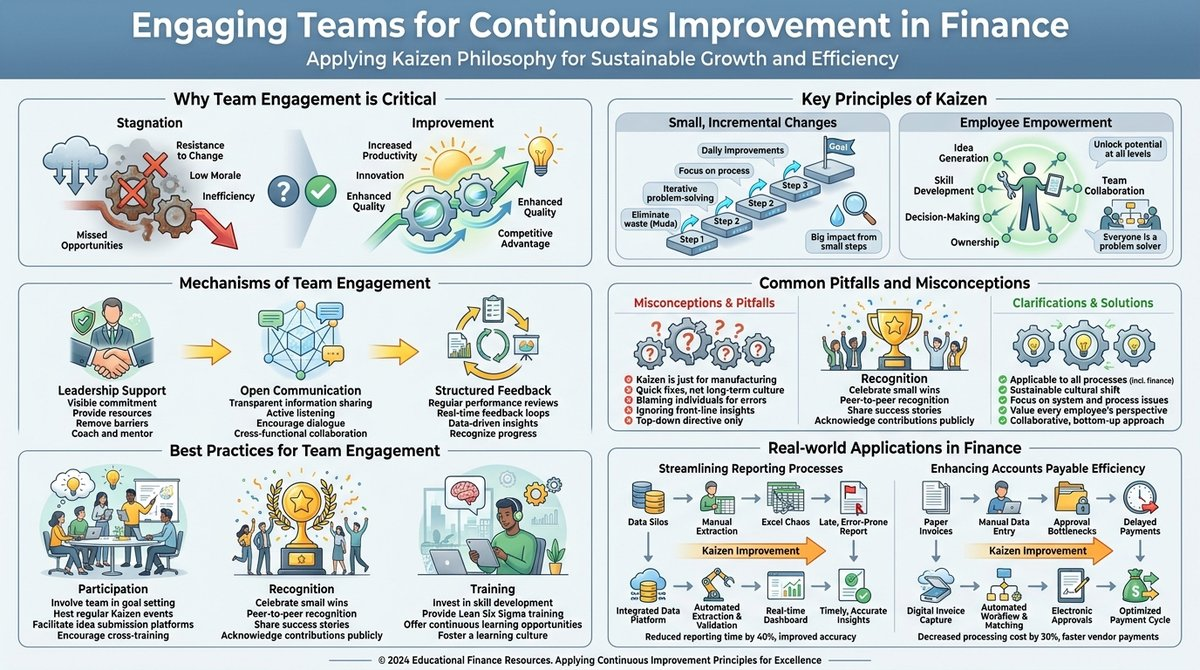
Kaizen, a Japanese term meaning "change for better," is a philosophy that focuses on small, incremental changes to achieve continuous improvement. In the context of finance, where accuracy and efficiency are paramount, applying Kaizen can be transformative. Here's why it matters:
-
Continuous Improvement: Kaizen emphasizes ongoing efforts to improve processes, practices, or standards without necessarily overhauling the entire system.
-
Employee Empowerment: It requires employees at all levels to participate in continuous improvement activities, encouraging ownership and accountability.
Connecting these principles to prior discussions, we saw how Kaizen aligns well with process optimization strategies. Now, we'll delve deeper into team engagement, a crucial element in realizing the full potential of Kaizen in finance.
The Mechanisms of Team Engagement in Kaizen
Engaging teams for Kaizen involves several strategic elements:
-
Leadership Support: The commitment from leadership is a catalyst for fostering a culture of improvement. Leaders set the tone by valuing input from all team members and recognizing their contributions.
-
Open Communication: Creating channels for free exchange of ideas helps identify improvement opportunities and boosts employee morale.
-
Structured Feedback: Regular, constructive feedback loops ensure suggestions lead to actionable change, maintaining momentum in the improvement journey.
Let's consider these elements in detail, drawing on past experience from successful implementations and addressing common challenges.
Best Practices for Team Engagement
1. Encouragement of Participation:
Organizations that encourage input from all levels often discover innovative solutions to complex financial challenges. Regular brainstorming sessions and suggestion boxes are practical tools to harness collective intelligence.
2. Recognition and Rewards:
Highlighting contributions in team meetings or offering rewards can significantly motivate employees, reinforcing the value of their participation in the continuous improvement process.
3. Training and Development:
Investing in training enhances skill levels, allowing teams to contribute more effectively to Kaizen initiatives.
Common Pitfalls and Misconceptions
Misconception: Kaizen is only suitable for manufacturing.
Clarification: While Kaizen is deeply rooted in manufacturing, its principles are versatile enough to improve efficiency in any sector, including finance.
Pitfall: Overemphasis on results over process.
How to Avoid: Balance outcomes with the understanding that Kaizen is a journey. Celebrate progress and small wins, not just end results.
Potential Challenges and How to Overcome Them
-
Resistance to Change: Introduce improvement initiatives as opportunities for skill development and career growth, rather than additional workloads.
-
Sustaining Momentum: Organize periodic reviews and updates to keep the team engaged and the process dynamic.
Real-world Applications in Finance
Example 1: Streamlining Reporting Processes
Consider a finance team drowning in data with cumbersome manual reporting processes. By implementing a Kaizen approach, they engage the entire team to identify bottlenecks and suggest minor tweaks, such as automating repetitive tasks through software solutions. This not only improves accuracy and saves time but also empowers employees to seek continuous improvements in their roles.
Example 2: Enhancing Accounts Payable Efficiency
Another example is a finance team that identifies a lag in the accounts payable process due to approval delays. Encouraged by a Kaizen culture, employees suggest modifications to the approval workflow, introducing digital signatures and setting up automated reminders. These suggestions, driven from the ground up, cut approval times significantly and enhance overall productivity.
Synthesizing Our Insights
Throughout this lesson, we’ve explored how engaging teams can amplify the success of Kaizen initiatives in finance. By fostering a supportive environment where every team member contributes to continuous improvement, you can drive meaningful change that enhances both individual roles and organizational outcomes.
Next, we'll build on this by exploring Tools and Techniques for Kaizen in Finance, equipping you with practical strategies to continue this transformative journey.