

History and Origins of Kaizen in Japan
History and Origins of Kaizen in Japan
The Journey of Kaizen: Origins in Japan
Understanding the Roots of Innovation: A Finance Perspective
Imagine a financial institution faced with increasing competition and shrinking margins. The pressure to enhance operational efficiency and cut costs without compromising service quality is intense. This is where Kaizen comes into play. Originating in Japan, Kaizen provides organizations with a methodical approach to continuous improvement, helping to streamline processes and enhance productivity in an ever-evolving financial landscape.
Now, more than ever, understanding the origins of Kaizen is crucial. By exploring how this philosophy was developed in Japan, financial professionals can learn valuable lessons that contribute to sustainable growth and competitive advantage. Let us delve into the historical journey of Kaizen.
Defining Kaizen: A Cultural and Philosophical Foundation
Kaizen is a Japanese term meaning "continuous improvement." It focuses on making small, incremental changes that collectively yield significant improvements over time. The philosophy centers on process-oriented thinking, encouraging a culture where employees at all levels are engaged in suggesting and implementing improvements.
Kaizen's origins are deeply tied to post-World War II Japan, where the need for rebuilding the economy was urgent. It sought to empower workers and utilize their insights and initiative to improve manufacturing processes, most notably seen in Toyota's production system. For financial services, this translates to improving workflows, reducing waste, and enhancing client satisfaction.
How Kaizen Became a Japanese Staple
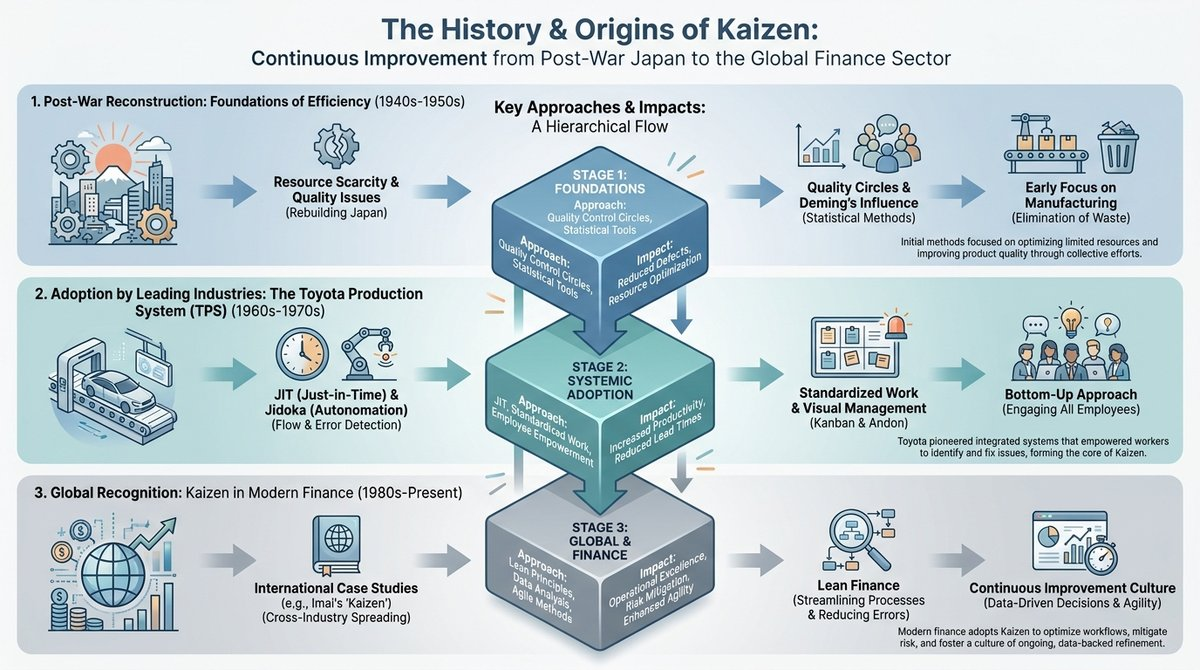
To grasp how Kaizen became embedded in Japanese industry, we must explore several pivotal moments and practices. Let's break down the historical progression into clear phases:
- Post-War Reconstruction (1940s-1950s):
Japan's focus was on rebuilding industries with limited resources. Government policies encouraged efficiency and quality improvements.
American experts like W. Edwards Deming introduced statistical quality control principles to Japanese manufacturers, influencing the rise of Kaizen principles. - Adoption by Leading Industries (1960s-1970s):
Toyota, among others, adopted Kaizen to streamline assembly lines and minimize defects. This approach became known as the Toyota Production System (TPS).
Emphasis was placed on efficiency, operational quality, and employee involvement— principles that became pillars of Kaizen. - Global Recognition (1980s-present):
As Japanese companies expanded globally, Kaizen was showcased as a major driver behind Japan's economic success.
Companies worldwide, including those in financial sectors, began embracing Kaizen for its systematic approach to problem-solving and growth.
Here is how these stages played out, focusing on strategic approaches and their impact:
| Stage | Key Approaches | Impact & Outcome |
|---|---|---|
| Post-War Reconstruction | Introduction of new management theories and quality control practices. | Greater emphasis on efficiency, leading to improved economic resilience. |
| Adoption by Industries | Toyota and others integrate Kaizen into manufacturing, emphasizing quality and employee input. | Significant productivity gains and superior product quality. |
| Global Recognition | Spread of Kaizen to Western industries, demonstrated through success stories of Japanese firms. | Broadened application in international markets, including finance, fostering innovation. |
Real-World Applications in Finance
Case Study 1: Process Optimization in Banking
In the 1990s, a Japanese bank struggled with lengthy processing times for loan approvals, affecting customer satisfaction and market competitiveness. Utilizing Kaizen principles, the bank identified bottleneck processes and redundant checkpoints.
-
Action Taken: Employees suggested reducing paperwork and standardizing application forms. They also introduced cross-training for personnel to handle multiple steps in the application process.
-
Outcome: Loan processing times decreased by 40%, leading to improved customer satisfaction and operational efficiency. This transformation was achieved with minimal capital investment, showcasing the power of Kaizen.
Case Study 2: Reducing Financial Waste in Asset Management
An asset management firm faced rising operational costs due to inefficiencies in transaction handling. Incorporating Kaizen, they formed small cross-functional teams to analyze and identify waste in daily operations.
-
Action Taken: Small modifications were implemented, such as streamlining data entry practices and automating regular reporting functions.
-
Outcome: Over a period of six months, the firm reduced transaction errors by 25% and operational costs by 15%. The project not only improved the bottom line but also enhanced team collaboration and morale.
The financial benefits derived from these Kaizen-driven processes demonstrate its practical value beyond manufacturing, affirming its applicability in modern finance.
Embracing Continuous Improvement
Reflecting on the history and impact of Kaizen provides valuable insights for finance professionals aiming to foster continuous improvement and competitive edge. As we have seen, even minor adjustments can bring about substantial benefits, making Kaizen an essential thread in the fabric of organizational development.
Next, we'll build on this foundation by exploring Key Principles of Continuous Improvement, guiding you in implementing Kaizen strategies effectively in your financial institution.