

Identifying Improvement Opportunities in Finance
Identifying Improvement Opportunities in Finance
Uncovering Opportunities for Financial Improvement
Imagine you're a financial manager in a mid-sized corporation grappling with mounting operational costs and inefficiencies in financial reporting. Your team is constantly under pressure to meet targets and deadlines. This scenario is common, yet many managers struggle with pinpointing where to begin improvements. That's where Kaizen, a Japanese term meaning "continuous improvement," can be a game-changer. By focusing on small, incremental enhancements, Kaizen offers a structured approach to achieving efficiency in financial processes, ultimately leading to more significant gains in productivity and cost-effectiveness.
Understanding Kaizen in Finance
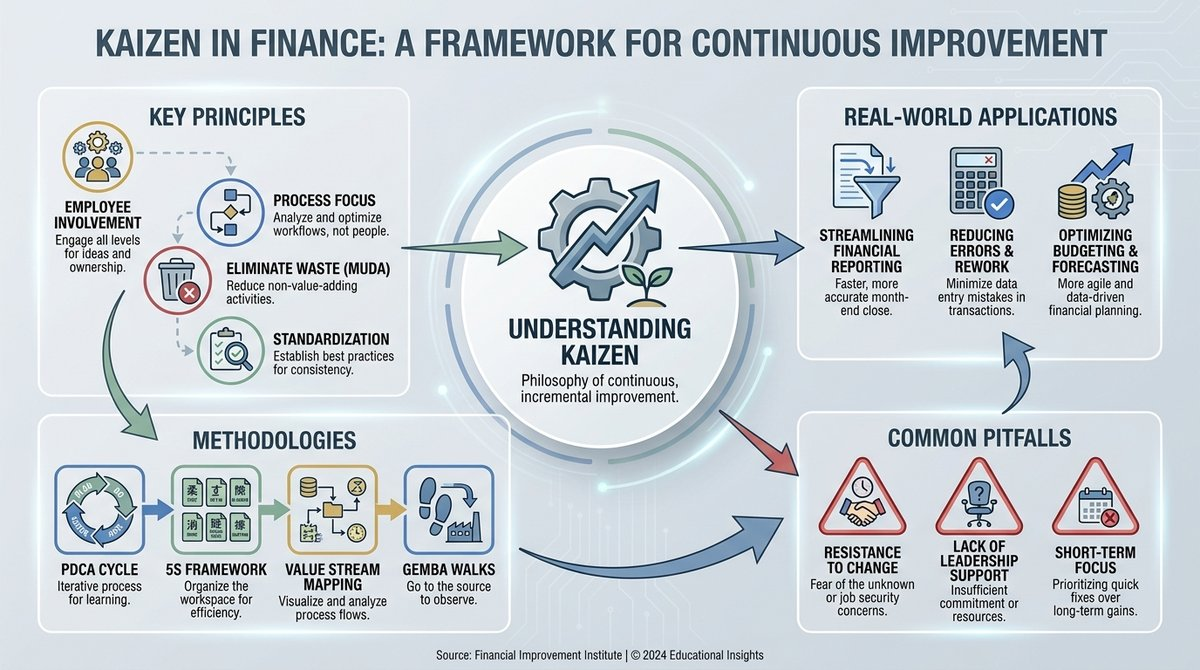
Kaizen is founded on the belief that making regular, small improvements can lead to substantial advancements over time. In the context of finance, this means continuously seeking ways to increase efficiency and reduce waste in processes such as budgeting, reporting, and auditing. Unlike large, disruptive changes, Kaizen emphasizes gradual progress, which is often more sustainable and less risky.
Key Principles of Kaizen:
-
Continuous Improvement: Ongoing effort to improve products, services, or processes.
-
Employee Involvement: Engaging all levels of employees to identify and solve problems.
-
Process Focus: Streamlining processes to enhance efficiency and effectiveness.
-
Data-Driven Decisions: Using data to guide improvements and track progress.
These principles can transform mundane financial tasks into opportunities for enhancement, driving innovation and efficiency across the organization.
Diving Deeper into Kaizen Methodologies
When applying Kaizen to financial processes, it's crucial to break down each task into its core components and examine them for potential improvement. This involves:
- Identifying Current Processes: Start by mapping out existing workflows to understand the full picture.
- Spotting Inefficiencies: Look for bottlenecks, repetitive tasks, or areas where errors frequently occur.
- Involving Teams: Gather input from employees who perform these tasks daily, as they often have valuable insights.
- Implementing Small Changes: Pilot small, manageable changes that can lead to improvements without significant risk or disruption.
- Evaluating Impact: Measure the results of these changes to ensure they lead to the desired improvements and adjustments when necessary.
Common Pitfalls and Misconceptions
- Overlooking Employee Insights: Neglecting team input can lead to missed opportunities for improvement.
- Impatience for Results: Kaizen emphasizes gradual change; expecting immediate results can lead to disillusionment.
- Focusing Solely on Costs: True improvement often comes from enhancing efficiency, not just reducing expenses.
By being mindful of these pitfalls, finance professionals can implement Kaizen more effectively.
Real-World Kaizen Applications in Finance
Example 1: Streamlining Financial Reporting
Consider a company struggling with its monthly financial close process, leading to delayed reports and strategic decisions. By applying Kaizen, the accounting team maps out each step in their reporting process, identifying where data collection and input errors happen most frequently. Through continuous small changes, like adopting automated data validation tools, they reduce errors by 35% and close reporting time by 20%.
Example 2: Enhancing Budgeting Efficiency
A financial team tackling cumbersome budget revisions benefits greatly from Kaizen methodologies. By involving junior team members who directly handle budget inputs, the team unveils inefficiencies in their spreadsheet usage. As a part of the Kaizen process, they switch to specialized budgeting software that allows real-time adjustments and consolidations. This change reduces the time spent on revisions by 50% and improves forecasting accuracy.
Both cases show how integrating Kaizen can lead to efficient financial processes, saving time and resources while improving the decision-making foundation.
Elevating Financial Efficiency with Kaizen
By embracing Kaizen in finance, organizations can foster a culture of continuous improvement. This approach enables them to stay competitive in a constantly evolving industry. Leaders and teams can create lasting value by understanding and implementing these principles and methodologies.
Transition into the next lesson seems fitting: "Next, we'll build on this by exploring Engaging Teams for Continuous Improvement."