

Importance of Kaizen in the Finance Sector
Importance of Kaizen in the Finance Sector
Kaizen's Transformative Impact on Finance
In today's rapidly evolving financial landscape, the need for continuous improvement is more critical than ever. Financial institutions face challenges such as volatile markets, regulatory changes, and increased competition. In this context, applying principles of Kaizen—originating from the Japanese words "kai" (change) and "zen" (good)—can significantly enhance operational efficiency and adaptability. Financial institutions adopting Kaizen can transform workflows by fostering a culture of incremental, ongoing enhancements.
Defining Kaizen and Its Core Principles
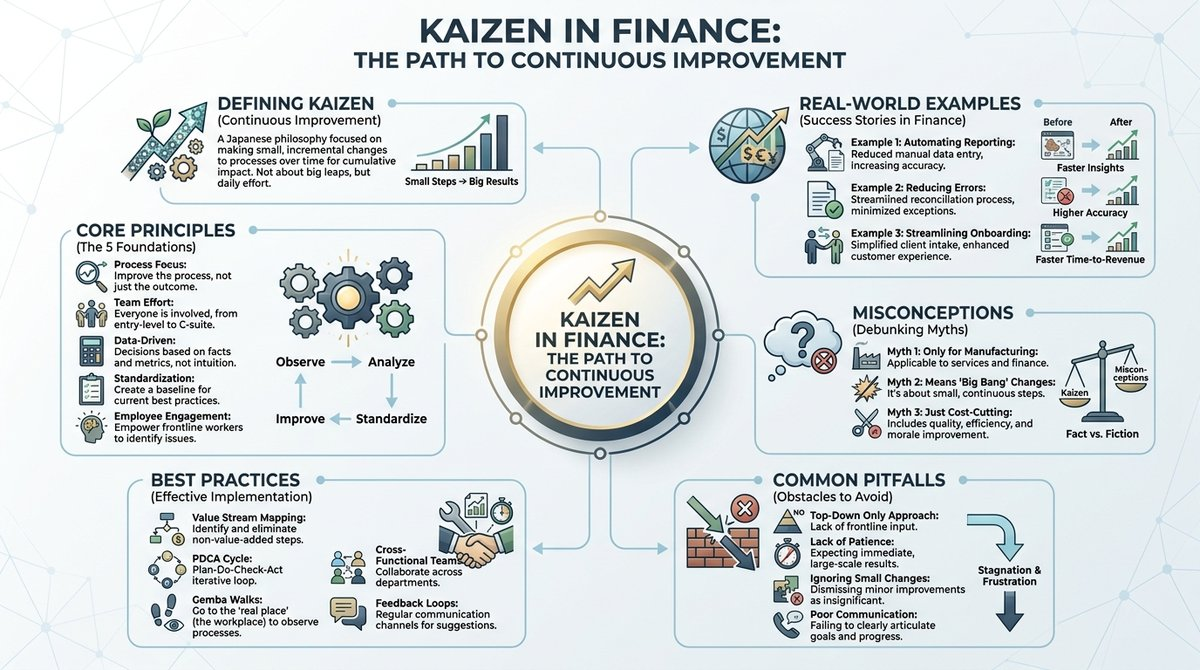
Kaizen is a philosophy that emphasizes the importance of small, continuous improvements that collectively lead to substantial organizational advances. In finance, it revolves primarily around optimizing processes to reduce waste, improve quality, and increase responsiveness.
Key Principles of Kaizen:
-
Continuous Improvement: Emphasizes ongoing evolution rather than drastic, single-step changes.
-
Employee Involvement: Engages employees at all levels to contribute insights and suggestions.
-
Standardization: Implements standards to ensure consistency, with a focus on measuring improvements.
-
Elimination of Waste: Encourages analyzing processes to remove inefficiencies and reduce time, cost, and errors.
This structured approach to change ensures that financial services not only keep up with industry trends but also anticipate new ones by constantly refining their processes and strategies.
Delving Deeper: Kaizen's Role in Financial Operations
Kaizen fuels a culture where every employee looks for ways to improve their work continuously. This ethos can be a game changer in managing financial services, from routine transactions to complex strategic decisions.
Best Practices in Applying Kaizen:
-
Begin with a Clear Vision: Establish clear objectives that align with the organization's goals.
-
Foster Open Communication: Encourage idea sharing to unlock innovative solutions.
-
Focus on Data: Utilize performance metrics to inform improvements and validate changes.
Common Pitfalls to Avoid:
-
Resistance to Change: Overcome employee reluctance with training and clear communication.
-
Short-term Focus: Avoid focusing solely on immediate gains at the expense of long-term strategy.
Misconceptions:
One common misconception is that Kaizen requires drastic restructures. Instead, it promotes minor, regular adjustments that cumulatively result in significant benefits over time.
Real-World Examples of Kaizen in Finance
Example 1: Streamlining Loan Processing
A major bank applied Kaizen to its loan processing workflow, aiming to reduce approval times. By examining each step, they eliminated unnecessary paperwork and automated verification processes. This not only decreased processing time by 30% but also improved customer satisfaction with faster service.
Impact:
-
Efficiency: Streamlined processes cut substantial time from routine approvals.
-
Customer Experience: Improved satisfaction and trust through quicker response times.
Example 2: Enhancing Compliance Procedures
A financial institution facing frequent audit penalties implemented Kaizen to refine its compliance checks. By mapping the existing compliance workflow and identifying bottlenecks, the institution introduced automated checks and continuous training sessions. This resulted in a 40% reduction in compliance-related issues.
Impact:
-
Accuracy: Automated checks minimized human error, ensuring better adherence to regulations.
-
Resilience: Proactive training fortified the team's ability to adapt to new regulations.
A Culture of Improvement
Adopting Kaizen transforms not just processes but mindsets. Institutions become agile, viewing obstacles as opportunities for enhancement rather than threats. By embracing a culture of continuous improvement, financial services can maintain a competitive edge and drive excellence in every facet of their operations.
In conclusion, the Kaizen approach equips financial institutions with the tools needed to navigate the complexities of the modern market. With every small change, organizations move closer to their strategic objectives, bolstering both operational efficiency and employee engagement.
A Culture of Continuous Improvement
-
Incremental Change: Small, continual adjustments lead to substantial progress over time.
-
Employee Empowerment: Kaizen fosters an environment where every team member contributes to improvement.
-
Sustained Competitive Advantage: Continuous enhancements keep institutions at the forefront of their industry.
As you reflect on the principles and applications of Kaizen, consider how this philosophy might be integrated into your workflows, leading to significant, measurable improvements across financial services. The focus on collaboration, efficiency, and ongoing refinement ensures that organizations are well-prepared to tackle future challenges.