

Selecting Samples and Randomization Techniques
Selecting Samples and Randomization Techniques
The Importance of Sample Selection in Randomized Controlled Trials
In the context of educational research, designing and executing Randomized Controlled Trials (RCTs) enables educators and researchers to evaluate the effectiveness of interventions with precision and confidence. Imagine introducing a new teaching method in several classrooms and finding dramatically different outcomes. Was the method itself the reason, or were external factors at play? Selecting the right sample and employing effective randomization techniques can help mitigate such uncertainties and ensure that educational interventions are rigorously and fairly assessed.
Understanding Key Concepts: Sample Selection and Randomization
Defining Randomized Controlled Trials
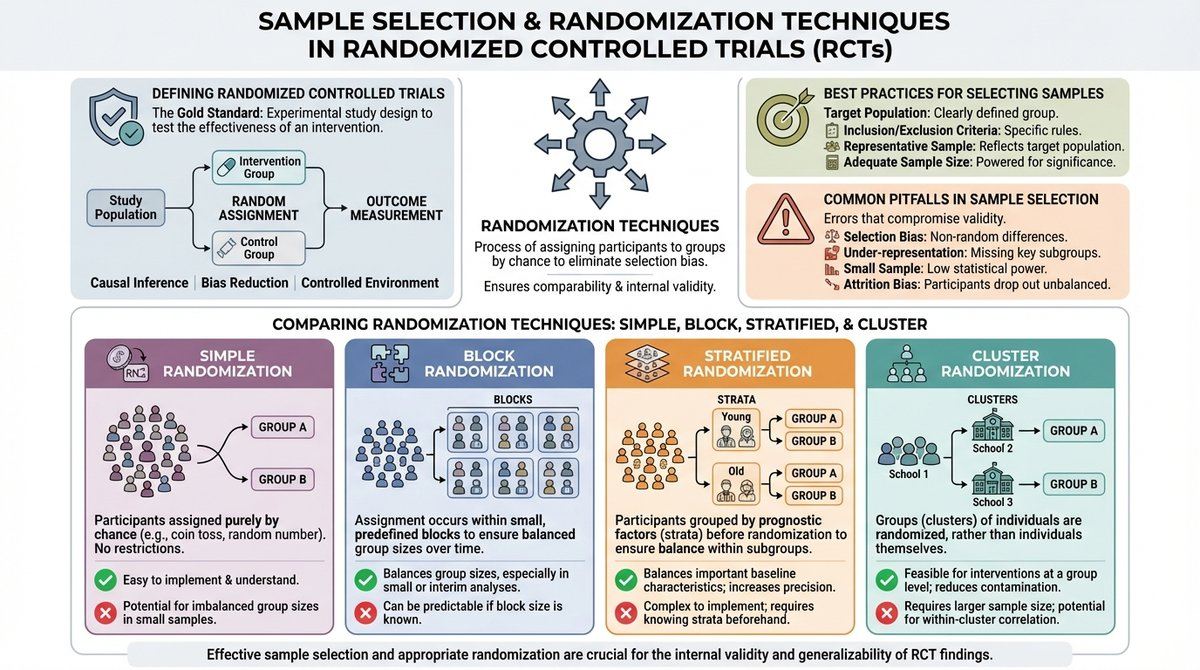
A Randomized Controlled Trial (RCT) is an experimental research method primarily used to evaluate the effectiveness of interventions. Participants are randomly allocated into either the intervention group receiving the treatment or the control group not receiving the treatment. This approach minimizes selection bias and increases the reliability of the findings.
Sample Selection refers to the process of choosing participants from a larger population for inclusion in an RCT. An ideal sample is representative of the broader population that the intervention is aimed at, ensuring the results are generalizable.
Randomization Techniques are methods used to randomly assign participants to different groups within an RCT. Randomization aims to distribute potential confounding variables equally among the groups, so differences between groups are more likely due to the intervention itself rather than external factors.
Why This Matters
RCTs are a gold standard for making causal inferences about educational interventions. Selecting the right sample ensures that the findings of the trial can be generalized to a larger population, making the results more applicable to real-world settings. Appropriate randomization techniques add to the credibility of the RCT by eliminating biases that might otherwise skew the results.
The Essentials of Sample Selection
Best Practices for Selecting Samples
- Define Your Population: Start with a clear definition of the population that your study will address. This should include demographic, geographic, and other relevant characteristics.
- Inclusion and Exclusion Criteria: Establish criteria for including or excluding participants from the study. These criteria should align with the research goals and ethical considerations.
- Sample Size Determination: Use statistical power analysis to determine the appropriate sample size. A sample that is too small may not detect an effect that truly exists, while an excessively large sample could be a waste of resources.
- Stratified Sampling: Consider stratified sampling to ensure all subgroups of the population are adequately represented. This involves dividing the population into strata and randomly sampling from each stratum.
- Recruitment Strategies: Develop effective recruitment strategies that ensure a representative sample. Recruitment methods should be ethical, efficient, and transparent.
Common Pitfalls in Sample Selection
-
Over-Generalization: Selecting a sample that is too homogeneous may lead to over-generalization, limiting the applicability of the findings.
-
Insufficient Power: Underestimating the required sample size can lead to inconclusive results or false negatives.
-
Bias in Recruitment: Relying too heavily on convenient sampling methods can introduce biases that affect the trial's outcomes.
Randomization Techniques: An In-Depth Look
- Simple Randomization
Definition: Each participant has an equal chance of being assigned to any group.
Benefits: Easy to implement and understand.
Drawbacks: May lead to imbalanced groups, particularly in small sample sizes. - Block Randomization
Definition: Participants are divided into blocks, and within each block, participants are randomly assigned to groups.
Benefits: Ensures balance in the number of participants across groups, especially important for smaller trials.
Drawbacks: Complexity increases with a larger number of blocks. - Stratified Randomization
Definition: Participants are stratified based on key characteristics before randomization.
Benefits: Ensures that important characteristics are evenly distributed across groups.
Drawbacks: Requires detailed data on participants before randomization. - Cluster Randomization
Definition: Groups or clusters of participants, rather than individual participants, are randomly assigned to different arms of the trial.
Benefits: Reduces contamination risk when individuals in the same cluster might influence each other.
Drawbacks: More complex statistical analysis is required.
Comparing Randomization Techniques
| Technique | Definition | Benefits | Drawbacks |
|---|---|---|---|
| Simple Randomization | Equal chance for any group | Easy implementation | Potential for imbalanced groups |
| Block Randomization | Ensures balanced groups by blocks | Balances numbers across groups | Increased complexity with more blocks |
| Stratified Randomization | Stratification by characteristics | Equal distribution of key characteristics | Requires comprehensive pre-randomization data |
| Cluster Randomization | Groups rather than individuals | Reduces intra-group contamination | Complex statistical analysis needed |
Application in Educational Research: Real-World Examples
Implementing a New Curriculum
Imagine a school district aiming to test a novel math curriculum designed to improve student outcomes. The district could utilize a stratified randomization approach to ensure the new curriculum is assessed across different student demographics, such as age and prior achievement levels, resulting in a more comprehensive understanding of its effectiveness.
Evaluating Teacher Training Programs
Consider an RCT designed to measure the impact of a new teacher training module on student engagement levels. Using a cluster randomization technique, teachers from different schools could be grouped within clusters, reducing the risk of information contamination across participants and providing a cleaner assessment of the module's impact.
The Broader Impact of Proper Sampling and Randomization
These examples underscore the importance of sample selection and randomization in ensuring the validity and reliability of RCTs in education. By carefully considering these elements, researchers can draw credible conclusions that inform policy and practice, thus contributing to better education system outcomes.
Takeaway
In RCTs, selecting a representative sample and employing appropriate randomization techniques are crucial for obtaining valid and generalizable results. The methodologies discussed provide a structured approach to designing robust RCTs, thereby enhancing the impact and reliability of educational research.
Now that the foundation is in place, we'll move into Ethical Considerations and Group Design.