

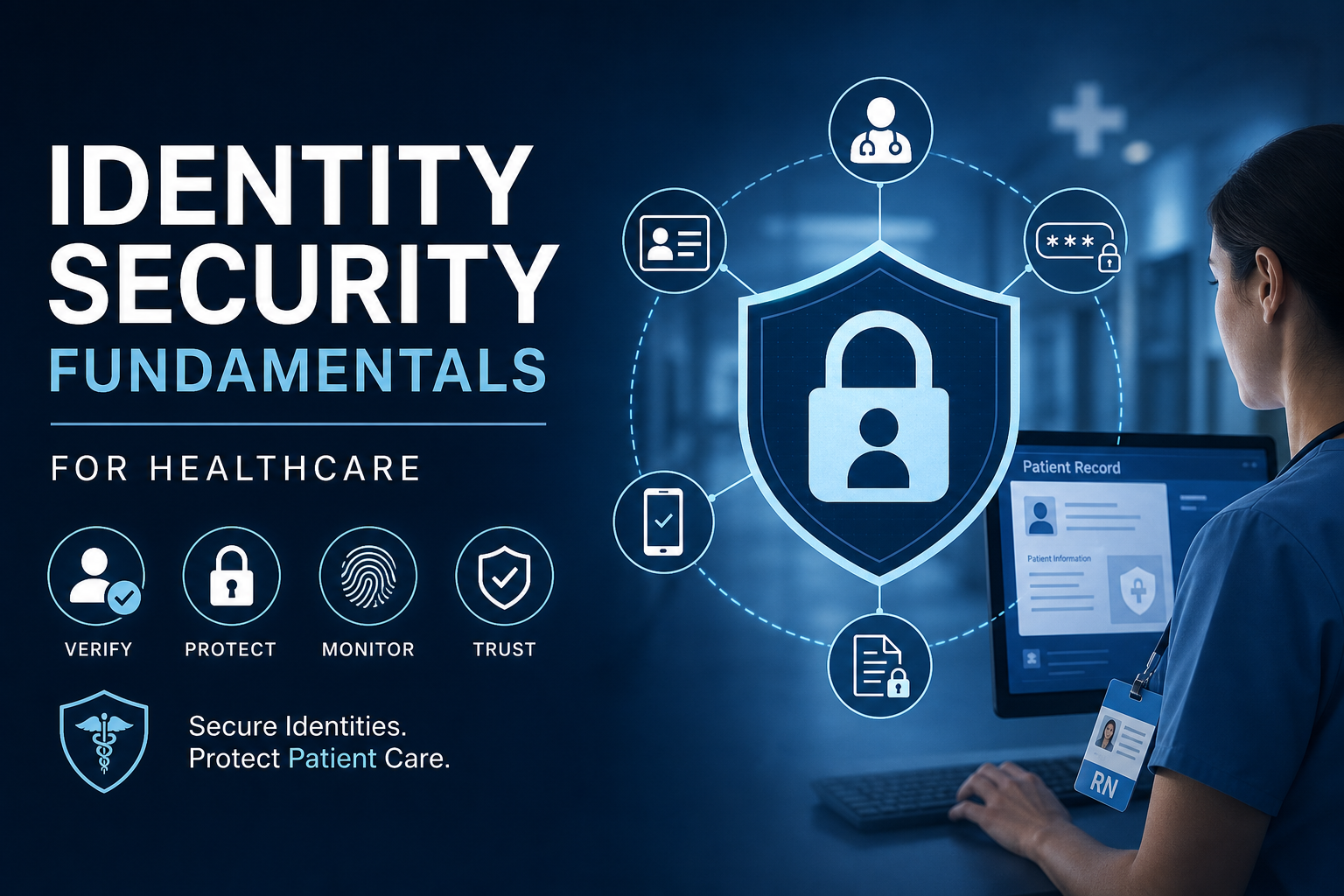
Identity Security Fundamentals for Healthcare
Course Scenario
Riverside Community Health System is preparing a new nurse, a traveling clinician, and a third-party billing specialist for access to its electronic health record and supporting systems. Throughout the course, their changing access needs illustrate how healthcare organizations protect patient information while enabling timely, appropriate care.
Section 1: Identity Security Foundations [1 hour]
-
Identity security in healthcare: The purpose of protecting digital identities and how compromised accounts can affect patient privacy, clinical operations, and trust.
-
Identity types and resources: Workforce, patient, service, device, and third-party identities across electronic health records, patient portals, medical devices, cloud applications, and administrative systems.
-
Authentication and authorization: How identity verification differs from permission assignment, using the Riverside users and their distinct responsibilities as examples.
-
Core security principles: Least privilege, need-to-know access, separation of duties, and balancing strong controls with timely access to patient care.
Section 2: Securing the Identity Lifecycle [1 hour]
-
Lifecycle-based access: How identity proofing, onboarding, role changes, temporary access, and prompt offboarding reduce risk as Riverside’s users join, move, and leave.
-
Stronger access controls: The roles of multifactor authentication, single sign-on, role-based access, and context-aware controls in protecting clinical and business systems.
-
High-risk identities: Additional safeguards for privileged administrators, remote workers, vendors, service accounts, and emergency-access accounts.
-
Detection and response: Access reviews, authentication monitoring, audit trails, and response steps for suspicious sign-ins, excessive permissions, or compromised credentials.
Section 3: Final Review
-
Review the relationship among digital identities, authentication, authorization, and access to healthcare information.
-
Revisit least privilege, need-to-know access, separation of duties, and lifecycle-based access management.
-
Summarize protections for workforce, patient, privileged, third-party, service, and device identities.
-
Identify future learning directions, including identity governance, privileged access management, zero trust, cloud identity security, and identity-related incident response.